


As AI reshapes how semiconductor competition actually works, South Korea is trying to turn its memory dominance into something broader and sturdier, a full ecosystem anchored by system semiconductors, localised supply chains, and a level of execution discipline that’s harder to buy than it is to build.
The New Moat Is Execution, Not Capital
The global semiconductor race has moved into a different phase than the one most people still picture. It isn’t really about who commits the most capital anymore. It’s about who can actually execute at scale, keep an entire ecosystem aligned, and turn investment into reliable output rather than delayed promises. In an AI-driven cycle, where speed to capacity, supply assurance, and ramp efficiency increasingly decide who captures the value, execution itself has become the moat.
That shift matters because what’s actually holding the industry back has changed too. Capital still matters, obviously, but it’s no longer the scarcest thing in the room. What limits competitiveness now looks more like infrastructure readiness, whether the tools and materials are actually available, how long qualification takes, how fast yield learning happens, and whether there’s enough specialised engineering talent to go around.
South Korea makes for one of the more revealing case studies in industrial resilience against that backdrop. Its strategy isn’t only about protecting what it already has in memory. It’s about rebuilding the wider ecosystem so the country can stay competitive in a market that’s become considerably more complex under AI’s influence.
 Korea’s Real Tension: Strong in Memory, Exposed in Structure
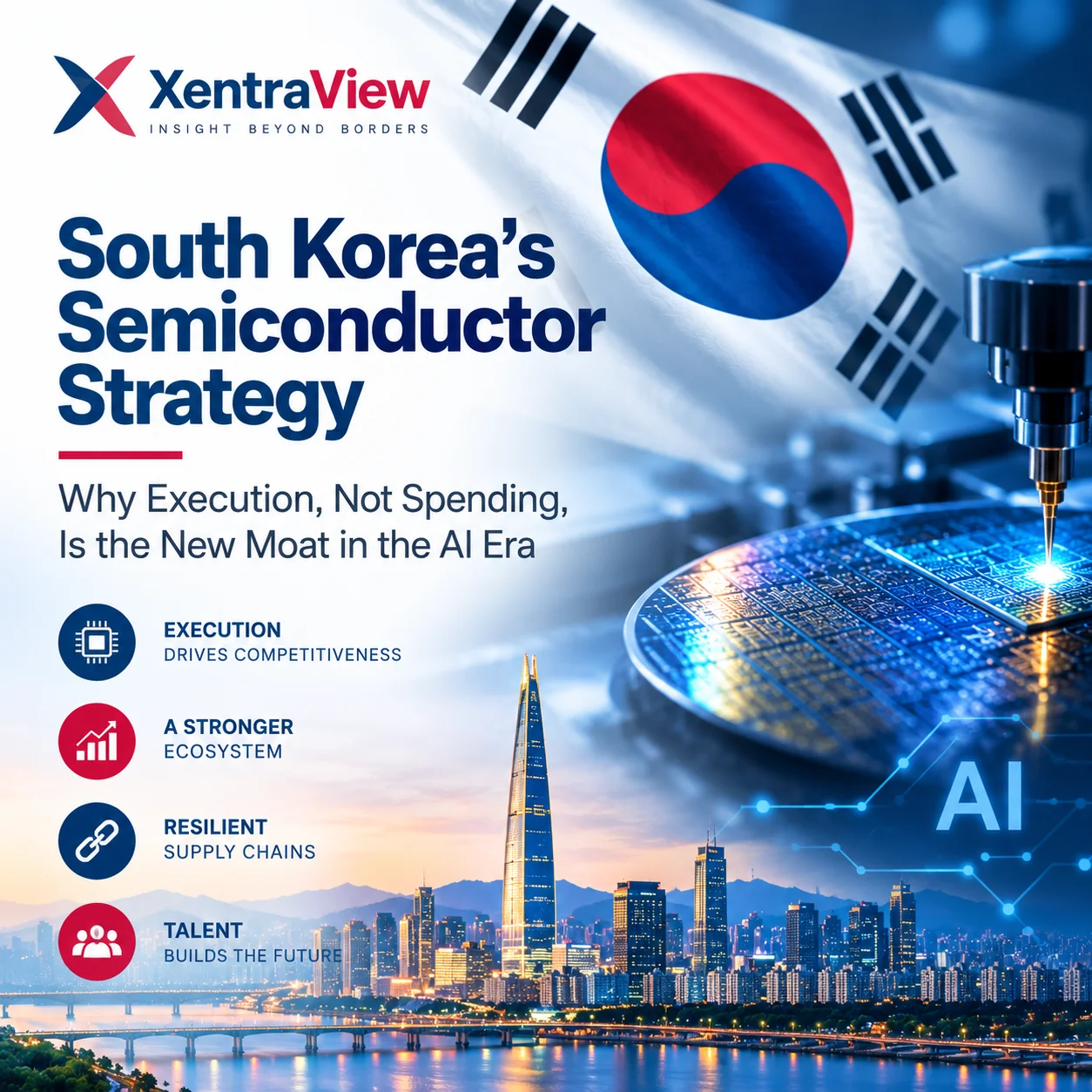 Korea’s Real Tension: Strong in Memory, Exposed in Structure
Nobody disputes Korea’s strength in semiconductors, but that strength is looking increasingly lopsided. Chips are the country’s largest export category by a wide margin, reaching roughly USD 173 billion in 2025, close to 24% of total exports. That makes semiconductors far more than an industrial priority. They’re a core piece of national competitiveness at this point.
But that same strength points straight at the vulnerability underneath it. Korea remains heavily concentrated in memory, which has been enormously profitable historically but leaves the country exposed on two fronts at once, the cyclicality that comes with volatile memory pricing and the concentration risk of having so much national performance tied to one segment.
That’s really the tension sitting at the center of Korea’s semiconductor policy. The question isn’t whether Korea can hold onto its memory leadership. It’s whether Korea can turn that leadership into something broader at the system level before concentration starts dragging on long-term resilience.
Why System Semiconductors Are the Real Test
If memory has been Korea’s foundation, system semiconductors are the country’s most important inflection point and its biggest source of upside. They offer a genuine way out of both memory’s cyclicality and its concentration problem.
System semiconductors cover a lot of ground: AI and high-performance logic chips like GPUs, NPUs, ASICs, and SoCs, power semiconductors that EVs and energy systems depend on, automotive semiconductors with their long product cycles and steep barriers to entry, and increasingly advanced packaging and heterogeneous integration, where system-level performance actually gets defined.
Memory has always been mostly a volume and scale game. System semiconductors are a different sport entirely, more design-intensive, more tied to specific applications, and more dependent on the end-market ecosystem around them. Competition shifts here from who can manufacture the most to who can actually integrate a system well.
AI isn’t just driving up demand for chips. It’s moving where the value sits across the whole stack. The AI semiconductor market is expected to grow at roughly a 24% compound annual rate between 2023 and 2028, potentially hitting USD 160 billion by the end of that stretch, and AI workloads increasingly lean on architectures that blend compute, memory, and interconnect together rather than treating them as separate concerns.
In practice, that pulls value toward compute architecture, energy efficiency, how data actually moves through a system, and advanced packaging approaches like HBM integration, chiplets, and 3D stacking. These happen to be exactly the areas where system semiconductor capability matters most.
For Korea, that turns system semiconductors into something well beyond a diversification play. It’s the actual test of whether the country can move from being a dominant component supplier to becoming a genuine full-stack semiconductor power.
Korea’s Answer: Building Resilience Through Ecosystem Expansion
Korea’s response reflects that reality pretty directly. The strategy is built on a clear pivot, from memory champion toward integrated semiconductor powerhouse. Two national targets sum up that shift well: raising materials, parts, and equipment self-sufficiency from around 30% to 50% by 2030, and growing system semiconductor market share from roughly 3% to 10% over the same period.
The logic behind that isn’t complicated. Korea is essentially trying to do three things simultaneously: cut supply-chain vulnerability by strengthening what it can produce domestically, spread its profit pools beyond memory into system semiconductors, and capture as much of the AI-driven growth as possible through advanced architectures, packaging, and computing applications.
That’s why system semiconductors sit right at the centre of the plan. Korea is explicitly funding AI and system semiconductor R&D, backing power and automotive semiconductor programs, developing next-generation architectures like processor-in-memory designs and on-device AI chips, and supporting the broader fabless ecosystem so design capability grows alongside manufacturing.
All of this is aimed squarely at Korea’s real structural gap: strong manufacturing muscle paired with comparatively thinner system design depth and a narrower ecosystem than its manufacturing scale would suggest.
What Actually Enables the Execution: Policy, Talent, and Clusters
Korea’s policy design matters here not because it’s dramatic, but because it’s built specifically to reduce execution risk. Where some competitors lean heavily on large upfront subsidies, Korea leans more toward policy stability and long-term incentive structures. That includes investment tax credits running 20 to 30% for equipment and facilities, R&D tax credits between 30 and 50%, and targeted funding aimed at next-generation semiconductors and AI-related innovation.
The point of all that isn’t to win a headline. It’s to lower the breakeven risk companies face and keep investment momentum going through the inevitable cycles the industry goes through.
Talent is the second big lever, and it’s one of the most underrated constraints in this whole industry. Korea’s strategy treats it as seriously as it deserves, aiming to train 150,000 semiconductor professionals by 2031, produce 45,000 specialised graduates, and expand visa programs to pull in engineering talent from beyond its own borders.
Clusters round out the third pillar. The broader strategy ties materials and equipment localisation, cluster development, and talent expansion together toward one goal, an ecosystem where design, manufacturing, packaging, suppliers, and specialised labour all reinforce each other rather than operating as separate silos. In system semiconductors especially, the bottleneck was never just fab capacity. It’s whether everything around the fab can actually function as one connected system.
Why This Matters: System Semiconductors as Korea’s Re-Rating Engine
System semiconductors matter here for a lot more than growth alone. They matter for valuation, for positioning, and for resilience over the long run. If Korea manages to build meaningful capability at the system level, the effect would be a genuine shift in where profit comes from, value capture extending well past memory’s usual cycles, margins that swing less violently, and greater exposure to fast-growing markets like AI, EVs, and industrial applications.
It would also change Korea’s position in the global value chain. Stronger system capability would let Korea participate more deeply in AI infrastructure, automotive electronics platforms, and next-generation computing architecture, moving the country from primarily a component supplier toward a genuinely integrated system-level player.
And it would widen the opportunity landscape around Korea’s broader semiconductor ecosystem too, creating knock-on opportunities in advanced packaging, in materials and equipment tied to logic processes, and in design, verification, and software layers that all sit downstream of stronger system capability. Seen that way, system semiconductors aren’t just another product line for Korea. They’re the engine behind how the country gets re-rated over time. This is where the real competitive frontier is heading.
What This Means for Investors and Executives
For investors, South Korea is worth evaluating as an execution ecosystem rather than a single incentive package. In markets where the biggest risks are schedule slippage, yield instability, and ecosystem bottlenecks, how reliably a country executes tends to matter more for returns than small differences in subsidy size ever will.
For executives, the strategic takeaway is about positioning. The opportunity in Korea has stopped being confined to memory. Supply partnerships, co-development deals, M&A, and localisation strategies should all be built around the expectation that Korea is actively expanding well beyond memory into a broader semiconductor ecosystem.
For both groups, talent deserves to be tracked with the same rigor as capital spending. Graduation numbers, retention rates, how practical the visa pathways actually are, and genuine engineering availability aren’t side notes here. They’re leading indicators of whether announced capacity ever turns into real output. In semiconductors, talent is what actually gates execution.
The Bottom Line
Semiconductor leadership in the AI era won’t go to whoever spends the most. It’ll go to whoever can design and execute a complete, resilient system, reducing concentration risk, localising the supply layers that matter most, building real system semiconductor capability, and aligning policy, capital, and talent so execution actually holds together end to end.
That makes Korea’s experience worth watching well beyond the semiconductor industry itself. It points to a broader shift happening across industrial competition generally: leadership is increasingly going to whoever can align policy, supply chains, skills, and technology into something coherent enough to actually execute, not just announce.
