


Industry Trends
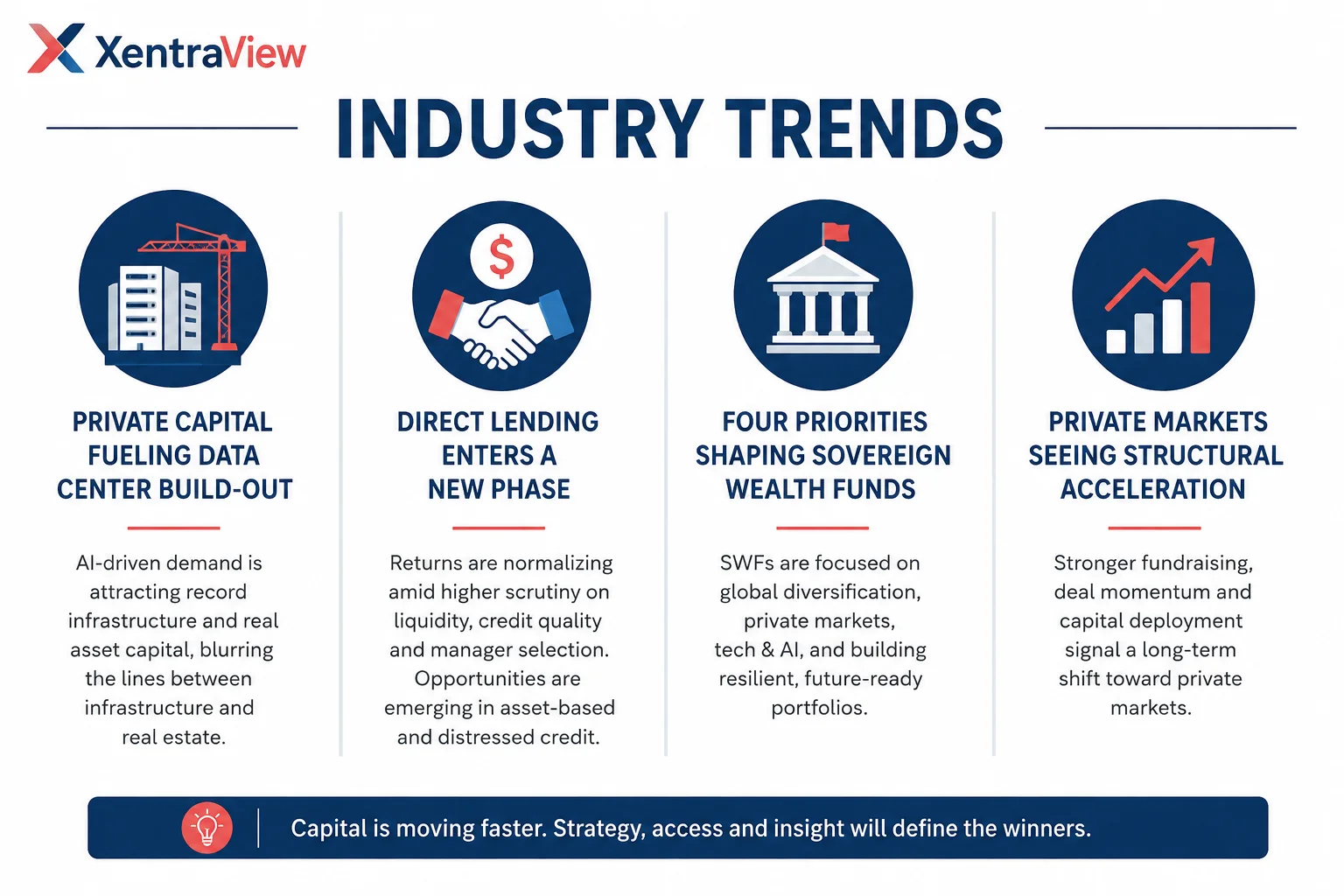
Private capital is fueling the data center build-out
The scale of AI-driven capital needs is starting to reshape how data centers get financed. Goldman Sachs Research now projects hyperscaler spending on AI and data centers will top $5 trillion by 2030, and infrastructure funds raised a record $221 billion last year alone, with growth expected to keep accelerating, potentially pushing infrastructure AUM past $3 trillion by the end of the decade.
To put the spending side in perspective, the four largest hyperscalers, Meta, Microsoft, Amazon, and Alphabet, are now projected to spend a combined $5.3 trillion on capex between 2025 and 2030, up from a $4.5 trillion estimate before this year’s first-quarter earnings even came out. Total industry spending on data centers, power, and computing could reach $7.6 trillion over that same window.
That kind of borrowing puts real pressure on liquid credit markets, which is exactly why private capital keeps growing in importance here. As of September 2025, infrastructure funds held just over $1.7 trillion in assets, with close to $400 billion sitting in dry powder, and private real estate funds held another $2.1 trillion with roughly $600 billion available to deploy. Add those together and you get close to $3.8 trillion in capital sitting ready across both categories. Fundraising has also gotten faster, larger funds are now closing in seven to twelve months, down from thirteen to eighteen previously, and by May 2026, nearly 700 infrastructure funds were out targeting a combined $555 billion.
What’s interesting is how blurry the line between infrastructure and real estate has become. Financing a data center touches land, power, networks, buildings, and equipment all at once, which doesn’t fit neatly into either category anymore. AI demand and energy security are pulling capital in, while investors are drawn to the diversification, income, and inflation protection this kind of asset can offer. One thing worth watching, capital expenditure plans are currently running ahead of actual data center construction. That gap matters for anyone thinking about long-term financing needs in this space.
 Direct lending enters a new phase
 Direct lending enters a new phase
Private credit has drawn unusual public attention so far in 2026, partly because concerns about AI’s effect on software business models are colliding with elevated redemption requests from semi-liquid evergreen lending funds. Liquidity terms, valuation marks, and portfolio quality have all ended up under a spotlight that wasn’t there a year ago.
Direct lending, the largest segment of private credit, is where most of the action is. Morgan Stanley’s Global Investment Office sees returns normalizing, driven by lower base rates following Fed cuts that started back in September 2024, spreads that tightened broadly through 2023 to 2025 before widening again recently on new loans, and credit losses that are creeping higher as defaults rise. Evergreen funds typically cap quarterly redemptions around 5% of NAV, and when requests get pro-rated, exit timelines can stretch out considerably. Sustained outflows can force managers into asset sales or added borrowing, which constrains what they can do going forward.
Manager selection matters more than it used to. Investors are digging into quality signals, payment-in-kind income, non-accruals, realized losses, and that sort of thing. Listed business development companies add another wrinkle, since sentiment alone can push them to a discount or premium against NAV. Because distributions drive most of the total return in this space, a discount can actually boost the quoted yield and create a tactical entry point for investors paying attention. Near-term prospects for direct lending look less favorable than they did a few years back, though opportunities appear to be building in asset-based finance and distressed or opportunistic credit.
Four priorities shaping sovereign wealth funds
Sovereign wealth funds have grown fast, reaching $15 trillion in AUM in 2025 at a 10.3% compound annual growth rate, outpacing most other institutional investors. The top ten funds now hold more than three-quarters of that total wealth, concentrated heavily in the Middle East, Asia, and Europe. For funds that receive regular state support, growth split roughly evenly between portfolio returns and government injections, including nearly $890 billion tied to hydrocarbon surpluses.
Home-market investment limits are a real constraint for a lot of large funds. Across the top twenty, about 70% of AUM still sits in public markets, with the remaining 30% in private assets, led by private equity at roughly half, followed by infrastructure and real estate at about a quarter each. Direct and co-investments now make up 50% to 60% of private deployments, up from around 40% just a few years ago. Over the past year, SWFs took part in $160 to $170 billion of private deals, with about $120 billion of that done directly, in line with the five-year average.
AUM is projected to hit $30 trillion by 2035, though the path there is getting more complicated given higher rates, compressed valuations, volatile hydrocarbon revenue, maturing private markets, and a fair amount of geopolitical fragmentation layered on top. Fund leaders are pointing to four things worth watching: recalibrating capital deployment toward more co-investment, shifting exposure east toward Asia, delivering on dual mandates that catalyze domestic industries like semiconductors and data centers, and transforming operating models with real 2035 targets rather than vague ambitions.
Mid-Year Review
What’s actually shaping private capital right now
Macro uncertainty, shifting rate expectations, inflation, and geopolitics are keeping private markets choppy this year. Deal volumes are uneven, exits are constrained, and fundraising keeps concentrating around the largest, most diversified platforms. The firms handling this best are using the volatility to their advantage, building out AI and data capabilities, investing in infrastructure, navigating a tougher exit market, weathering private credit’s first real stress test, and tightening operating infrastructure so they can scale across increasingly complex platforms.
Sponsors aren’t just building portfolios anymore, they’re building platforms with real sector depth, specialist talent, and better data use behind them. KKR’s acquisition of Arctos Partners in May, worth $1.4 billion in initial consideration, is a good example, it adds a sports franchise entry point and a scaled GP solutions platform in one move. AI is now baked into investment theses across the board, pushing capital toward compute, energy, and digital infrastructure. Apollo’s $3.5 billion capital solution for Valor’s xAI compute transaction, DigitalBridge’s acquisition of ArcLight, and the Blackstone-Google AI cloud venture all point in the same direction, toward asset-heavy, cash-flowing, inflation-linked sectors.
The dealmaking picture itself is uneven. Volumes in the first quarter came in roughly flat year over year, but deal value dropped 14% to $482 billion, and over a third of portfolio companies have now been held longer than five years. Europe stayed active, Asia-Pacific has been more selective, and Japan’s take-private activity is picking up. Global infrastructure spending is projected to climb roughly 60% to $7 trillion by 2050. Private credit AUM already exceeds $2.2 trillion and could reach $4.5 trillion by 2030. Looking forward, resilience will likely favor managers with strong distributed-to-paid-in ratios, solid fund operations, and real transparency around liquidity and risk.
A “Groundhog Day” cycle for private equity
The recovery of private equity has been waiting for, but it keeps getting pushed back. Early-year optimism ran into tariff turmoil, then an AI-driven shakeout in software valuations, redemption stress across private credit, and an oil price spike tied to conflict in Iran. Dealmaking fell sharply as a result, and only the very top-tier assets are still clearing at strong prices. Even so, nothing looks fundamentally broken, public equities are still buoyed by AI enthusiasm, the global economy keeps expanding, and dry powder remains ample. A real, sustained upturn needs a stable equilibrium and some acceptance that this is simply a tougher era, higher rates, stubbornly elevated asset prices, and a lot less multiple expansion than firms got used to.
Tech uncertainty remains elevated, with wide dispersion showing up in Q1 buyout marks against public market data. Buyers are leaning toward businesses with less near-term AI exposure and less geopolitical risk, favoring physical, labor-intensive operations with domestically oriented revenue. With purchase multiples and financing costs both elevated at once, the bar for genuine operational value creation has never been higher.
Exits remain sluggish after four straight years of record-low distributions relative to NAV, with implied capital cycles now stretching to roughly seven years. Assets underwritten before or during the pandemic have absorbed inflation, rate hikes, trade disruption, and AI-driven change all at once, straining both GP-LP relationships and fundraising. Marks-to-exit values, though, appear more stable than a lot of LPs seem to believe. Fundraising will likely lag until exits and distributions strengthen meaningfully, probably another twelve to eighteen months out. Four ideas worth holding onto here: deal math has gotten genuinely harder, leaning into AI across workflows and operating models isn’t optional anymore, avoid getting caught in the middle of the market, and put resources behind the clear winners rather than spreading thin.
Market Sentiment
Private markets are still in favor, but LPs are getting choosier.
Coller Capital’s 44th Global Private Capital Barometer, published in late June and covering 108 LPs overseeing more than $2 trillion, found geopolitics is playing a much bigger role in allocation decisions than it used to be; more than a third of respondents said it matters more now, rising close to half in both Europe and Asia-Pacific. LPs are trimming their GP relationships too, with nearly a quarter planning to reduce the number of managers they work with over the next three years, up noticeably from where that number stood back in 2020. Commitment momentum hasn’t slowed though, roughly a third expect to accelerate commitments over the next two years, and more than half expect to hold pace.
Views on exits are genuinely split. Some LPs think GPs are balancing liquidity and value creation reasonably well, others want liquidity sooner, and a smaller group thinks top assets are actually getting sold too early. Continuation vehicles are now a standard part of the toolkit, GP-led secondaries hit roughly $106 billion in 2025, and a good chunk of LPs expect that activity to keep growing even as traditional exit routes recover.
More LPs are bracing for an increase in so-called zombie funds, and when asked what they’d want to see in no-fault situations, fee step-downs came out well ahead of other options like incentive resets or manager replacement. Private credit allocation growth is cooling off from where it was, though credit secondaries are expected to be a bigger driver of secondary market growth going forward. On AI specifically, most LPs see it mainly as a cost-efficiency tool, and a majority expect it to widen the performance gap between managers, even as gut instinct stays central to how a lot of these decisions actually get made.
Private credit hits a cooldown.
The rapid growth private credit has seen is slowing, particularly on the US direct lending side. New loan issuance fell to $44.76 billion in the three months through May, down roughly 40% from $74.56 billion in the first quarter. Issuance tied to private-equity-backed borrowers dropped nearly 37%, and lending tied specifically to leveraged buyouts fell about 34%.
Managers have turned more cautious, softer fundraising, elevated redemptions, closer scrutiny of loan quality, and renewed competition from cheaper syndicated loans are all playing a role. Credit-quality concerns intensified after weakness showed up in software debt specifically, a sector with heavy exposure across leveraged finance and private credit, where a widely tracked loan index fell nearly 5% year-to-date through the end of May, compared with a modest gain for the broader leveraged loan market.
A sustained slowdown in new loan originations could squeeze manager earnings by limiting asset growth and transaction fees, especially if funds hold onto cash instead of deploying it while facing redemption pressure. Early second-quarter filings already show that pressure hasn’t let up, both Blackstone and Cliffwater capped withdrawals at 5% after redemption requests came in well above those limits. Fundraising remains muted too, roughly flat against 2025 and still below where it stood in 2023, with retail appetite for private credit fading noticeably in recent months.
Market Opportunity and Challenges
Exit readiness is becoming a year-round discipline.
EY’s Global PE Exit Readiness Study for 2026 finds that private equity firms are treating exit readiness less like a one-time event before a sale and more like something to maintain continuously. Distributions are running around 15% of NAV, well below the typical 20% to 25% range, and assets are simply being held longer than they used to be.
Early preparation makes a real difference. The vast majority of GPs report better valuations when they start exit planning well ahead of time, ideally twelve to twenty-four months before an actual sale. Alignment between sponsors and management teams matters just as much, most GPs and management teams describe themselves as mostly or fully aligned on timing and valuation expectations, though management teams say they’d benefit from more support building a defensible, data-backed equity story for buyers. Proving out value creation initiatives in exit EBITDA remains a genuine sticking point, one that puts a premium on strong data and rigorous performance attribution.
AI has quietly become a real differentiator in exits. The share of GPs who see AI as a significant challenge has more than doubled, which reflects how much buyers now expect a credible AI strategy backed by real data, not just AI activity for its own sake. With exit windows often brief and diligence more intense than it used to be, being genuinely ready ahead of time is turning into a real competitive edge.
Infrastructure debt as a defensive play
Infrastructure debt is getting attention as a defensive allocation, offering resilient income with historically lower volatility and correlation than a lot of alternatives, backed by contractual or regulated revenue and essential-service economics. Demand is accelerating on the back of the energy transition, digitalization, and urbanization, and the G20 estimates a $15 trillion global infrastructure spending gap by 2040. As traditional lenders pull back, private capital has stepped in to fill roughly 53% of infrastructure debt financing in the first half of 2025.
The mid-market, loans under $100 million, is a large but frequently overlooked corner of this space. Nearly 800 sub-$100 million transactions were reported in 2025, compared with fewer than 300 deals above $1 billion, which points to real opportunity for proprietary origination with solid credit fundamentals and less competition for deal flow.
The asset class itself carries some attractive structural features, including duration matching, stable and often inflation-linked cash flows from long-term contracts, and downside protection through senior secured positions and tangible collateral. Ratings data show meaningfully lower default rates for infrastructure debt compared with non-financial corporate credit, along with lower loss rates overall. Manager selection is critical here, this is a relationship-driven market, and platforms with established sourcing and sector expertise are the ones positioned to access the better deals.
Sector Update
Industrial PE investment hits new highs
Private equity and venture investment in industrials is on track for a meaningful year-over-year jump in 2026, as managers lean into AI infrastructure, supply chain realignment, and defense spending. Announced industrial deals already totaled $82.06 billion globally through the first five months of the year, compared with $140.99 billion for all of 2025. If the current pace holds, 2026 could end up surpassing 2022’s $160.47 billion, the strongest year in at least six years.
The drivers here are pretty concrete, the global data center build-out, electrification, grid modernization, supply chain rerouting, and rising defense budgets. With software facing real AI-driven disruption, a lot of investors now see industrials as something closer to a hard-asset safe haven. Apollo’s leadership has called it a genuine industrial renaissance, spanning utilities, digital infrastructure, energy transition, advanced manufacturing, defense, and AI-adjacent data businesses. Anything touching a data center right now is in real demand, as one industrial-focused investor put it recently. Apollo’s move to take a majority stake in Kelvion for $2.33 billion, drawn partly by its fast-growing data center segment, is a good illustration of where the interest is concentrated.
Aerospace and defense pulled in $23.36 billion in 2025, trailing only trading companies and distributors. Europe’s growth has picked up, though most capital is still targeting North America, helped along by a US shift toward cheaper, reusable, AI-enhanced defense systems. The largest deal of 2025 was the $28.22 billion buyout of Air Lease Corp. Median deal size climbed to $11.6 million last year, up from $7.2 million in 2024, as investors steered away from smaller, less resilient targets.
