


Most investment firms and growth-stage enterprises don’t lack ambition. They lack a system that turns research into decisions on time. Talk to any head of strategy or corporate development long enough and you’ll hear a version of the same story. A market-entry study takes six weeks and lands after the window has closed.
A due diligence team pulls data from four different vendors, none of which talk to each other, and someone spends the last two days before the deadline just reconciling numbers. A pipeline of “qualified” leads turns out to be a spreadsheet nobody has touched since Q1. The tools exist. The expertise exists. What’s missing is the connective tissue between them.
 The Real Bottleneck Isn’t Talent
 The Real Bottleneck Isn’t Talent
When research and business development stall inside an organization, the instinct is to blame headcount or budget. Add analysts, buy another subscription, and hire a BD lead. In practice, the more common problem is structural: research, financial modeling, deal sourcing, and outreach all live in separate workflows run by separate teams, often with separate tools and no shared source of truth.
A CFO at a mid-market PE firm can have world-class analysts and still watch a deal slip because valuation work, commercial diligence, and investor outreach never converged into one coherent view. The people did their jobs. The process didn’t connect them.
This shows up just as often on the growth side. A company expanding into a new market might have strong sales instincts but no systematic way to map accounts, score opportunities, or keep outreach consistent once the initial burst of enthusiasm fades. Momentum dies in the handoff between “we researched this” and “we acted on it.”
What Changes When Research and Execution Sit on One Platform
The organizations that consistently close deals faster and enter markets more confidently tend to share a pattern. They don’t treat research as a one-off deliverable that gets handed over and forgotten. They treat it as an ongoing input that feeds directly into decisions, and they build the infrastructure to make that handoff seamless.
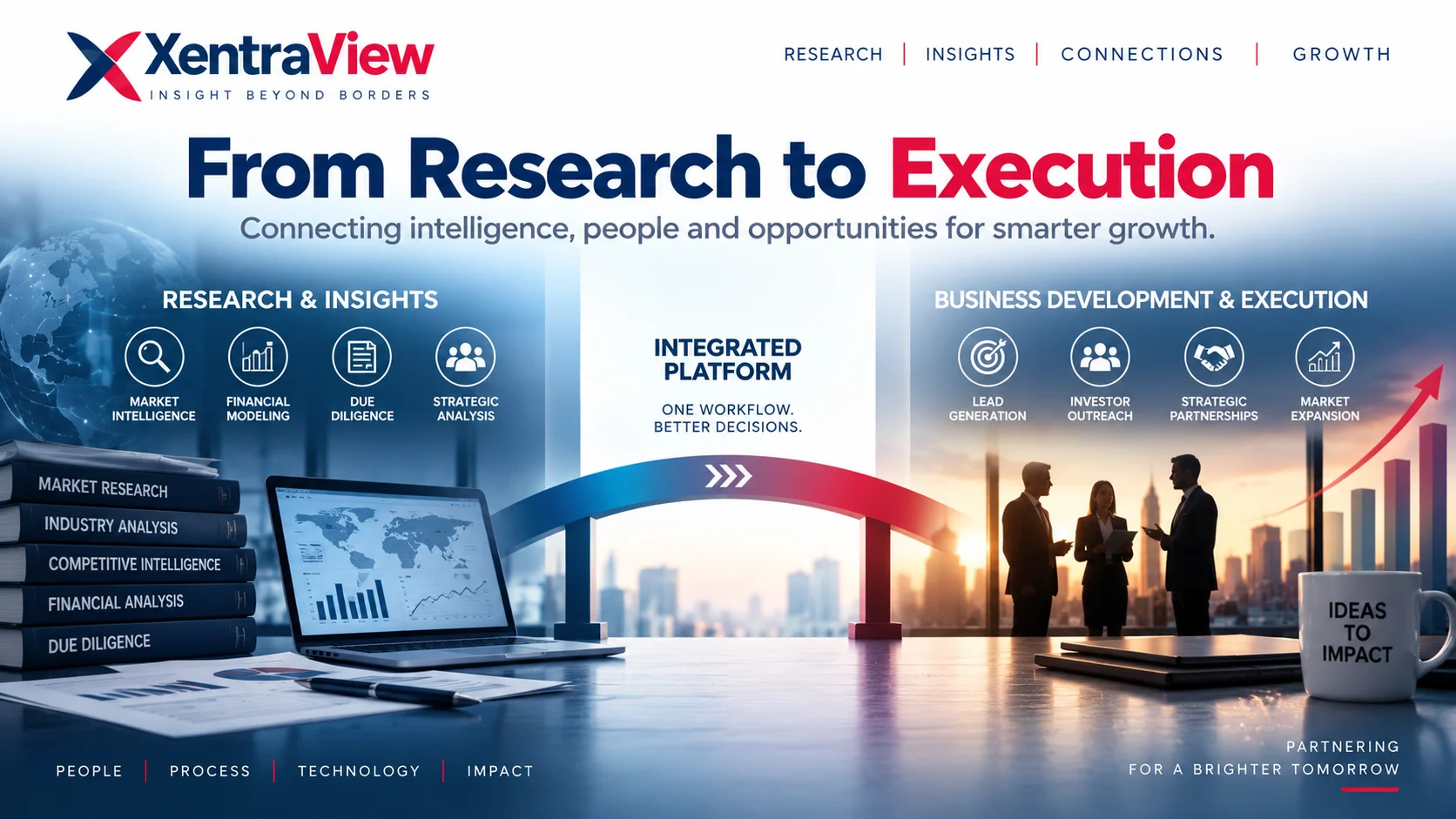
That’s the thinking behind Xentraview’s integrated Research & Investment Services and Business Development Support platform. Instead of asking clients to stitch together a research vendor, a financial modeling team, and a lead-generation shop, the platform brings deal sourcing, financial analytics, valuation, due diligence, and portfolio monitoring together with lead generation, investor outreach, and strategic account mapping in one continuous workflow.
For an investment firm, that might mean the same team that builds the valuation model is also tracking the commercial diligence findings that feed into it, rather than two groups working from different versions of the truth. For a growth-focused enterprise, it means market research and business development execution are built on the same account intelligence, so a target list isn’t just accurate on the day it’s delivered, it stays current as outreach happens.
Where AI Actually Helps, and Where It Doesn’t
There’s a lot of noise right now about AI replacing research teams outright. What we see in practice is narrower and more useful: AI-assisted workflows that handle the repetitive parts of research, structured data pulls, first-pass document review, and pattern-matching across large datasets, so experienced analysts spend their time on judgment calls instead of data assembly.
That distinction matters. A model can accelerate a literature scan or flag inconsistencies across a set of filings. It can’t replace the judgment of someone who has sat across the table from a management team and knows which claims deserve more scrutiny. The firms getting real value from AI-assisted research are the ones using it to compress the mechanical work, not the ones trying to automate the analytical work.
Starting Point
If your research function and your business development function are running as separate tracks with separate metrics, that’s usually the first thing worth fixing before adding more tools or more headcount. A platform that connects the two doesn’t just save time. It changes what decisions are possible, because the people making them are working from the same information at the same moment.
Xentraview works with investment firms, financial institutions, and growth-focused enterprises to build that connective layer, combining experienced analysts with technology-enabled workflows so research and execution stop operating as separate businesses inside the same company.
