


A business development strategy is usually judged by a familiar set of numbers: leads generated, meetings booked, deals closed, and revenue added. Those numbers matter, but they only tell part of the story. A pipeline can be busy and still be doing very little for the company behind it.
When business development is tied to where a company actually wants to go, it does more than fill a calendar with calls. It shapes who a company gets to negotiate with, which markets open up first, and how quickly a firm can move when an opportunity appears. It turns outreach into positioning, not just activity.
Most organizations don’t approach it that way. Research gets treated as a task to hand off, outreach gets treated as a volume game, and account mapping happens in isolation from wherever the company’s actual growth priorities live. The result is a lot of motion and a portfolio of contacts that doesn’t add up to much strategic ground. The real question isn’t how to generate more leads. It’s how to make every hour spent on research and outreach actually build something the business can use later.
 Why Most Business Development Programs Fall Short
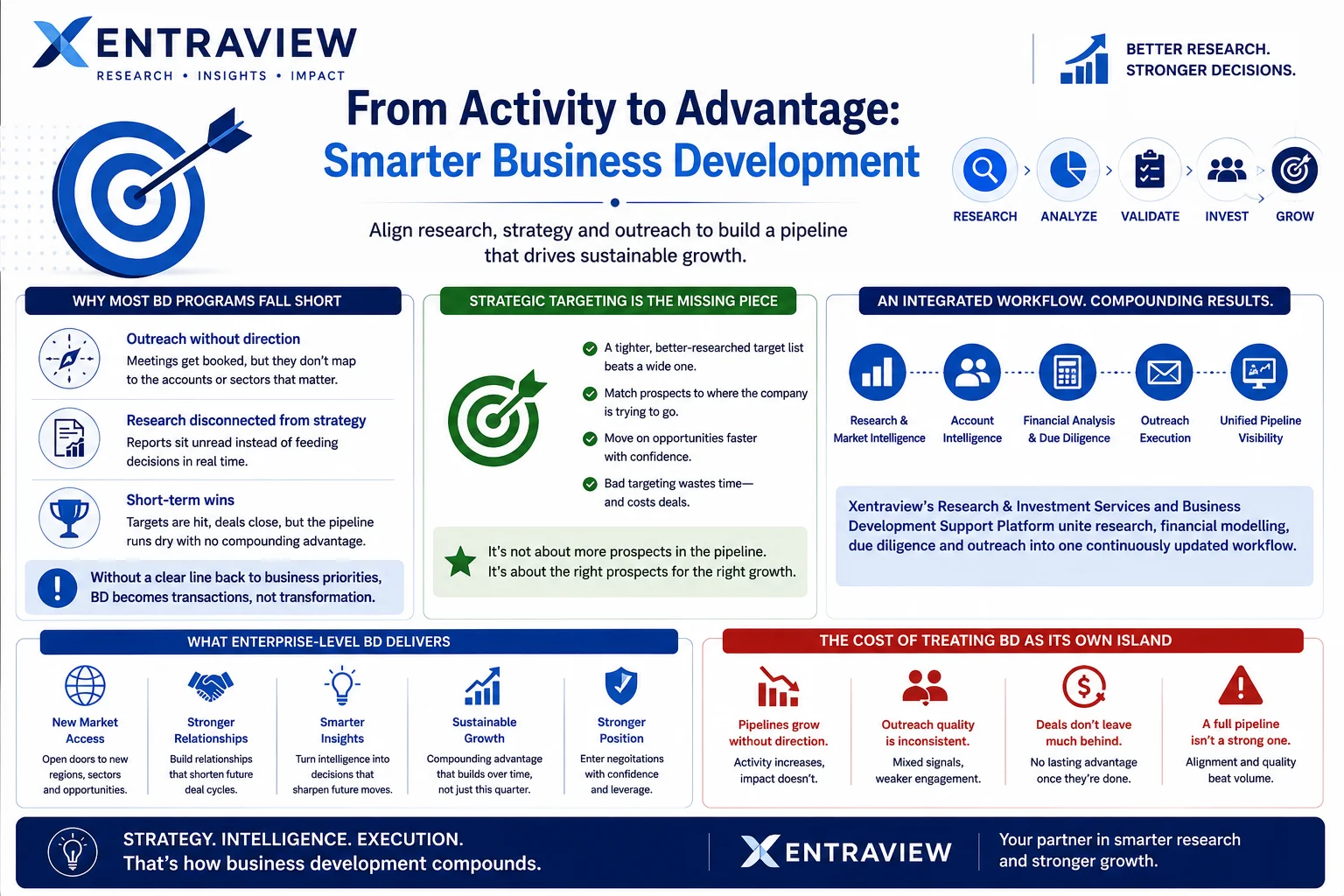 Why Most Business Development Programs Fall Short
Plenty of BD functions are busy without being especially useful. Research teams chase data points, outreach teams chase meetings, and leadership wants growth, but nobody’s connecting the three. When that happens, a company can hit its activity targets and still not be any closer to where it wanted to be.
A few patterns show up again and again:
- Outreach without direction. Meetings get booked, but they don’t map to the accounts or sectors that actually matter to the business.
- Research disconnected from strategy. Market intelligence sits in a report nobody reads twice, instead of feeding decisions in real time.
- Short-term wins. A deal closes, a target gets hit, and then the pipeline is empty again with no compounding advantage left behind.
Without a clear line back to business priorities, BD turns into a series of transactions rather than something that builds on itself.
Strategic Targeting Is the Missing Piece
The value of a BD effort has less to do with how many prospects are in the pipeline and more to do with how well those prospects match where the company is trying to go. A tighter, better-researched target list beats a wide one every time, because it’s the difference between chasing anyone who might say yes and going after the accounts that actually move the business forward.
This is becoming harder to ignore as decision cycles get shorter. Investment firms and growth-stage companies are expected to move on opportunities faster than they used to, with less room to figure things out after the fact. That puts pressure on the research and account intelligence sitting behind every outreach effort, because bad targeting doesn’t just waste time; it costs the deal to a competitor who did their homework first.
Why the Workflow Itself Is the Problem
So where does the disconnect usually come from? It’s rarely a talent problem. It’s an infrastructure one.
Market research lives in one place, outreach tracking in another, and financial modeling or due diligence work happens somewhere else entirely, often with a different team and a different set of assumptions. Business development doesn’t have visibility into what research just found. Research doesn’t know which accounts the BD team is already circling. Leadership sees a revenue number every quarter and not much of the reasoning behind it.
Fixing that means putting research, account intelligence, financial analysis, and pipeline activity into a single, current view instead of a set of disconnected reports. That’s the gap Xentraview works in day to day. Its Research & Investment Services and Business Development. The support platform pulls commercial research, financial modelling, due diligence, and outreach execution into one continuously updated workflow, so research and business development teams are looking at the same picture instead of comparing notes after the fact. Once that’s in place, growth stops being something a company figures out deal by deal.
What Enterprise-Level Business Development Actually Looks Like
At the enterprise level, business development stops being a standalone function chasing its own targets and starts running alongside investment strategy, market entry planning, and portfolio priorities. Every account gets evaluated not just on whether it might convert, but on what it opens up: a foothold in a new market, a relationship that shortens the next deal cycle, and insight that sharpens the next decision.
That’s the shift worth making: judging BD activity not only by what it closes, but by what it sets up.
The Cost of Treating BD as Its Own Island
When business development runs separately from research and strategy, the costs show up slowly. Pipelines grow without necessarily reflecting where the business is actually headed. Outreach becomes inconsistent in quality. Deals that do close don’t leave much behind once they’re done.
A full pipeline isn’t automatically a strong one. What matters is whether the accounts in it line up with where the company is trying to go and whether the work behind each one holds up when it’s time to negotiate or scale.
Building a Business Development Strategy That Actually Compounds
A stronger approach usually starts with getting research and BD looking at the same priorities. In practice, that means:
- Mapping accounts and markets against actual growth priorities, not just accessible ones.
- Feeding research and due diligence findings directly into outreach, rather than after the fact.
- Giving research, BD, and leadership shared ownership of the same pipeline view.
- Tracking not just deals closed, but relationships and market position built along the way.
- Treating financial modelling and valuation work as part of the BD process, not a separate step tacked on later.
Commercial research, competitive intelligence, portfolio monitoring, and outreach execution all matter individually. What turns them into leverage is having them work off the same information at the same time.
Where This Is Heading
Business development is moving past the idea that more outreach automatically means more growth. The bigger opportunity is using research and account intelligence to build a position that holds up over time, not just a quarter of good numbers.
Good analytics can point to the right accounts and the right moments to reach out. What actually compounds is connecting that intelligence to where the business is trying to go next and keeping research and BD close enough that neither one is working from an outdated picture.
