


The Commercial Problem: Evidence Burden Has Become an Access Risk
Market access and HEOR teams are being asked to do something genuinely hard right now: prepare evidence faster, adapt it across a growing number of markets, and hold up under HTA and payer scrutiny that keeps getting sharper. The real challenge isn’t dossier preparation anymore, not really. It’s decision readiness, knowing which evidence actually matters, where the gaps sit, which assumptions are likely to get challenged, and how quickly a team can turn a pile of fragmented evidence into something that holds up as an access strategy.
That evidence burden has quietly turned into an access risk in its own right. Find out about a gap too late, and it weakens launch readiness, shakes payer confidence, and undermines the whole reimbursement conversation before it’s even started.
This pressure isn’t easing up either. The EU’s Joint Clinical Assessment process, in force since January 2025 for new oncology medicines and advanced therapy medicinal products, is a pretty clear signal that evidence planning needs to become something consistent and reusable across markets, not something rebuilt from scratch each time. For pharma teams, the practical goal is straightforward: cut the manual evidence burden, get affiliates better prepared, and catch access risks before they turn into late-stage submission problems.
Where Agentic AI Is Actually Showing Up in HTA and Market Access
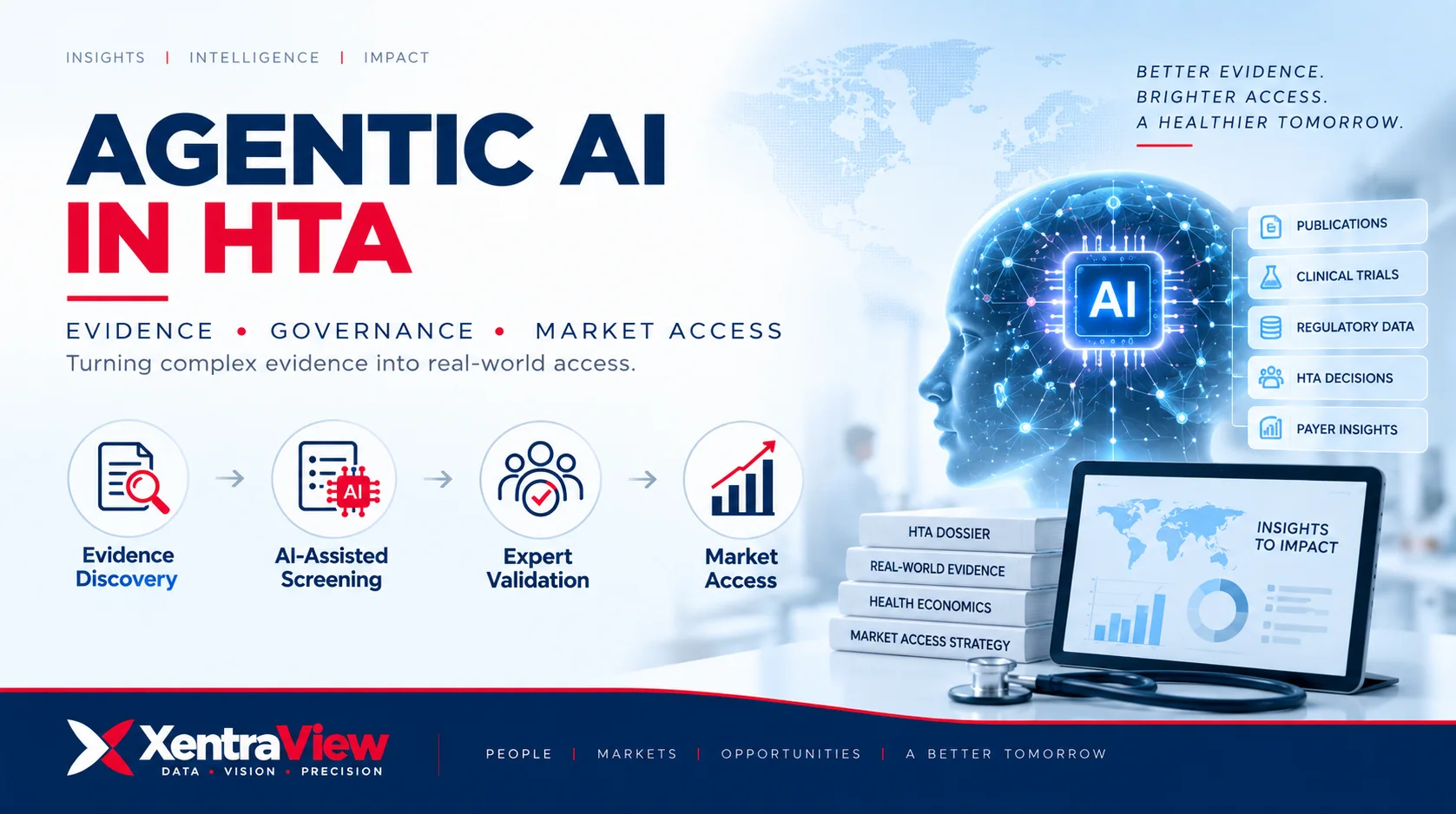
Teams working across HTA and market access are already testing agentic AI on evidence and market access workflows, particularly wherever the volume is high and the review work is repetitive. Discovery agents can scan publications, clinical trial reports, regulatory documents, prior HTA decisions, and payer-relevant sources. Screening and extraction agents can support systematic literature review work by prioritizing records and pulling out endpoints, comparators, safety outcomes, quality-of-life measures, utilities, resource-use inputs, and study characteristics.
From there, synthesis agents can compare findings across sources and flag things worth a closer look, weak comparator alignment, immature survival data, assumptions that don’t line up with each other, missing utility inputs, and generalisability that’s shakier than it first appears. Dossier and response agents can help with evidence table generation, cross-referencing, drafting narrative sections, and getting ahead of the questions payers are likely to ask.
The opportunity here is real, but so is the risk sitting right next to it. AI can speed the work up considerably, but HTA decisions still rest on expert interpretation, traceability, and governance that a model alone can’t provide. Both EMA and WHO guidance are clear on this point, transparency, accountability, and human oversight aren’t optional extras when AI touches health and medicine decisions.
What XentraView Does Differently: Agentic AI With Evidence Governance
We don’t position XentraHTA as a generic document summariser or a push-button HTA engine, and that distinction matters more than it might sound. Plenty of AI tools can summarize a document or answer a question about something you upload. XentraHTA goes further by connecting specialised agents across the full HTA workflow, evidence discovery, SLR screening, extraction, synthesis, risk assessment, dossier support, and wrapping all of it in expert-defined evidence logic, source traceability, and validation checkpoints that a generic tool simply doesn’t have.
Under the hood, the platform combines retrieval-augmented generation, document intelligence, structured extraction, evidence tagging, and workflow orchestration. Evidence discovery agents identify the publications, trial documents, regulatory assessments, prior HTA decisions, and payer-relevant sources that actually matter. Screening and extraction agents capture endpoints, comparators, safety outcomes, quality-of-life measures, resource-use inputs, utilities, and study characteristics, each one traceable back to its source. Synthesis agents compare evidence across everything gathered, flag inconsistencies, surface gaps, and structure the output into something HEOR teams can actually build a model from. Risk and dossier agents help anticipate payer questions, generate evidence tables, draft narratives, and get everything cross-referenced and submission-ready.
What sets this apart isn’t just that AI is involved somewhere in the process. It’s how tightly that AI is controlled. Every output is grounded to its source, mapped against the evidence logic, and passed through Human-in-the-Lead checkpoints before it goes anywhere near a dossier. Domain experts define the PICO logic, set the inclusion and exclusion rules, review how well extraction actually performed, validate the model-ready inputs, interpret what the evidence gaps actually mean, and sign off on the final value narrative. That combination, agentic orchestration, evidence grounded in source, HEOR-aware structuring, and expert oversight at every stage, is really what separates this from a standalone AI tool built mainly for summarization.
| Typical standalone AI tools | XentraHTA’s approach |
| Summarise uploaded documents or answer one-off questions | Connects specialised agents across discovery, screening, extraction, synthesis, risk analysis, and dossier support |
| Generate a narrative with limited workflow context | Maps outputs to HTA evidence logic, PICO structure, HEOR requirements, and payer-relevant questions |
| Provide answers that often need manual source-checking | Grounds every output to source documents, with traceability built in for validation |
| Extract information in loosely structured formats | Structures clinical, economic, comparator, endpoint, utility, and resource-use data into HTA and HEOR-ready formats |
| Leave quality reviews mostly to the user. | Builds in human-in-the-loop checkpoints for extraction review, assumption validation, and final narrative approval |
| Operate as a standalone technology tool | Pairs agentic AI with managed services, real HTA and HEOR expertise, medical writing support, and market access delivery experience |
XentraHTA isn’t an AI layer bolted onto summarisation. It’s a governed, expert-led evidence workflow built to turn source-grounded outputs into something genuinely HTA-ready and HEOR-ready.
What We Learned Testing AI-Assisted Screening Across Five Therapy Areas
We put an AI-assisted evidence-screening workflow through its paces across 989 records spanning five disease areas: vitiligo, narcolepsy, immunoglobulin A nephropathy, hidradenitis suppurativa, and amyotrophic lateral sclerosis. The goal wasn’t to hand final inclusion or exclusion decisions over to AI. It was to figure out where AI genuinely improved screening accuracy, consistency, and prioritisation, and just as importantly, where it needed more guardrails around it.
What came out of that exercise was that a single AI screening pass doesn’t perform the same way across therapy areas. Terminology shifts, study design varies, endpoint reporting isn’t consistent, publication patterns differ, and inclusion criteria change from one disease area to the next. That’s exactly why an agentic setup makes more sense than a single model trying to make every call, specialised agents handling distinct tasks, evidence discovery, relevance screening, extraction, and quality checks, each doing one thing well rather than one model doing everything adequately.
That multi-agent design improves accuracy through task specialisation, cross-agent validation, confidence-based routing, and a closer look at anything where agents disagree. Records with uncertain or conflicting classifications get escalated for a human to adjudicate, and because the reasoning is linked back to source, reviewers can actually check why a recommendation was made rather than taking it on faith.
That testing shaped a more disciplined workflow in the end, one built around calibration specific to each indication, threshold tuning, ongoing recall monitoring, and human review that isn’t optional. Within XentraHTA, agentic AI handles the speed and prioritisation, and domain experts retain the final say on what evidence actually moves forward into synthesis, HEOR analysis, or HTA-ready output.
AI for Scale, Experts for Judgment, Managed Services for Repeatable Delivery
For pharma teams, the payoff is fairly concrete: faster evidence readiness, earlier visibility into risk, and fewer surprises showing up at the last minute. A human-in-the-loop workflow can cut down manual review time, produce structured evidence tables much faster, flag comparator and endpoint risks well before they become a problem, build evidence assets that actually get reused across markets instead of rebuilt each time, and leave teams better prepared for whatever questions HTA bodies and payers throw at them. It also tends to reduce the rework that shows up late, since gaps surface before the dossier is finalised rather than after.
HTA isn’t heading toward full automation, and it shouldn’t. What’s coming is expert-led and AI-enabled work, where market access and HEOR teams still decide which evidence carries weight, which assumptions can actually be defended, and how the value story gets told. That’s exactly what XentraHTA is built for: AI doing the scaling, experts doing the judgment calls, and managed services making sure delivery stays repeatable rather than reinvented every time. That’s really the core of what Human-in-the-Lead AI does, it turns evidence overload into an actual market access advantage.
What’s Next
If your HTA workflows still feel reactive and scattered across teams, the first step is figuring out exactly where evidence work is slowing down readiness for the market. XentraHTA brings agentic AI, expert governance, and managed services together to help teams move from just generating evidence to actually having an evidence strategy.
The question at this point isn’t really whether to bring AI into HTA. It’s how to do it in a way that scales, stays accountable, and actually supports the decisions that matter.
Reach out for an HTA Evidence Readiness Diagnostic to find out where the real bottlenecks are, get an honest read on AI readiness, and walk away with a practical roadmap for scalable, expert-led HTA support.
