


Bank consolidation is back on boardroom agendas in a way it hasn’t been for a while. Recent moves by Santander, NatWest Group, and Fifth Third Bancorp all point in the same direction: scale, diversification, and capital efficiency are once again driving strategic thinking at the top of the industry.
The trend shows up most clearly among regional and mid-sized banks, where M&A has become a tool for strengthening competitive position, extending geographic reach, and squeezing out operational efficiency that’s harder to find organically.
A handful of structural forces are pushing this momentum along. Banks want a bigger footprint and broader product capabilities. Digital transformation needs have only grown more urgent. Return on tangible equity is under closer scrutiny than it’s been in years. And margin pressure, paired with rising funding costs, is pushing institutions toward acquisition as a faster route to growth than building everything in-house ever could be.
But here’s the thing worth remembering: the value in any of these deals is rarely locked in at announcement. It gets built, or lost, through how well the deal actually gets executed, from identifying the right target all the way through integration and scaling the combined institution afterward. Strategic intent gets you to the table. Execution capability, backed by real data, analytics, and operational scale, is what determines whether the deal actually pays off.
Thinking About the Whole Lifecycle, Not Just the Deal
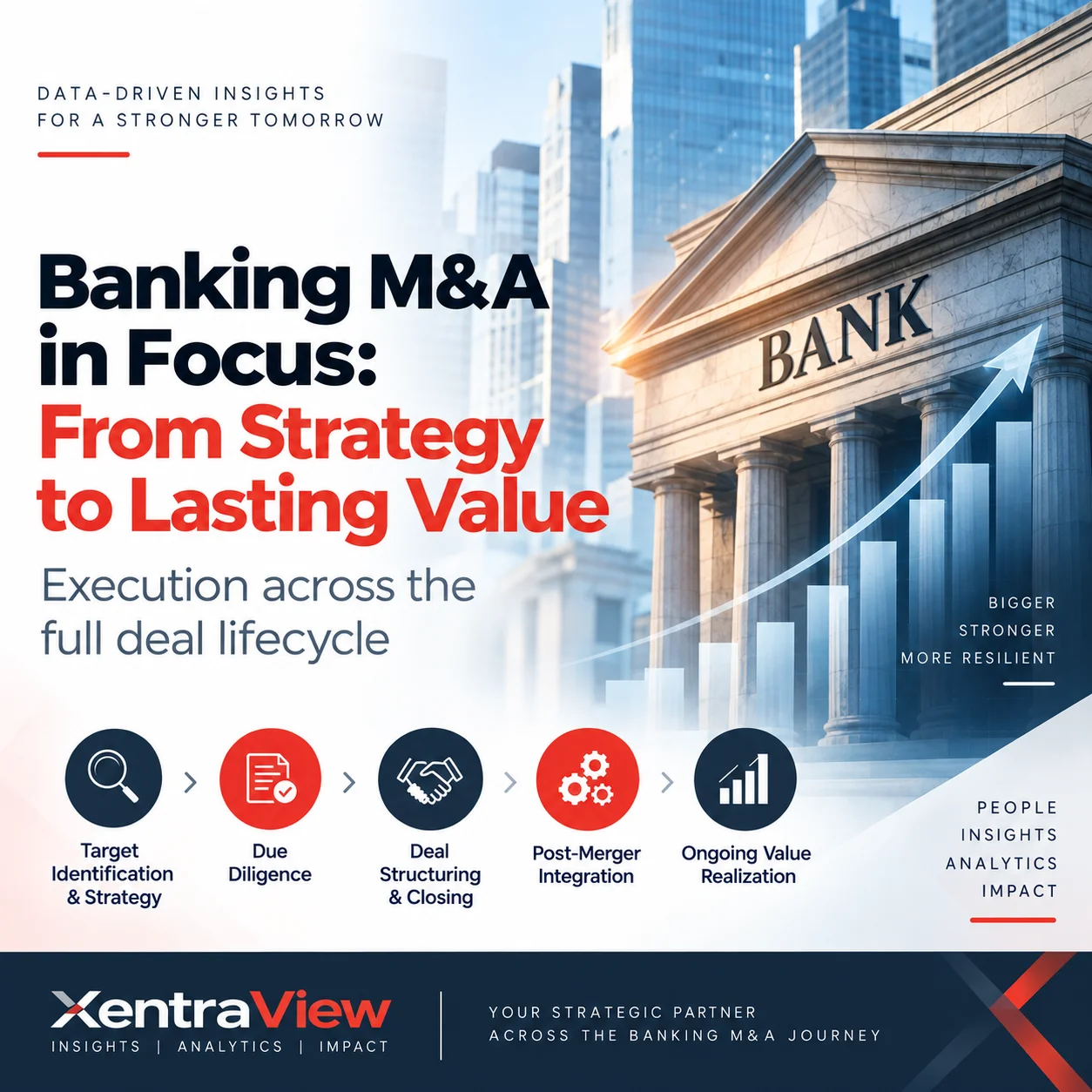
Bank acquisitions tend to move through five stages that are more connected than they might look on paper: strategic evaluation and target identification, comprehensive due diligence, structuring and closing the deal, post-merger integration, and then ongoing value realisation once the dust settles.
Advisory firms handle a lot of the structuring and negotiating, but the heavy execution work falls mostly on internal teams, corporate development, risk, credit, and operations. These teams frequently need more analytical depth and process scale than their day-to-day setup was built for, especially once transaction cycles pile workload on top of everything else already on their plate.
That’s really where XentraView fits in. We work alongside banks navigating exactly this kind of demand, bringing domain expertise, analytics, and AI-enabled tools into the picture to help teams execute more effectively at every stage of the M&A lifecycle.
Supporting Strategic Evaluation and Target Identification
At the earliest stage of a deal, banks need a genuinely clear picture of potential targets, the markets they sit in, and the portfolio dynamics underneath them, all of it feeding into stronger deal sourcing and origination. Corporate development teams are often working under tight deadlines here, needing fast intelligence and analytical support to evaluate an opportunity and build a credible investment case.
The support that tends to matter most at this stage includes market mapping and competitive intelligence, screening and identifying acquisition candidates, profiling companies against strategic fit, benchmarking against comparable transactions, going deep on the relevant industry or sector, and helping build out the materials that go in front of an investment committee.
XentraView supports this through data-driven research and analytics that give banks what they need to make informed calls quickly, evaluate an opportunity properly, check that strategic alignment actually holds up, and build a narrative backed by real numbers rather than assumptions. Given how iterative this stage tends to be, bringing in external analytical capacity alongside an internal team usually sharpens the target identification process rather than slowing it down.
Strengthening Due Diligence With Data and Analytics
As a deal moves further along, due diligence becomes the phase where value assumptions actually get tested and hidden risk starts to surface. Unlike routine lending work, M&A diligence has to look at a target institution holistically, financially, credit, operationally, and regulatory, all at once rather than one dimension at a time.
Broken down operationally, that diligence work falls into roughly four buckets.
Financial due diligence covers asset quality (the loan book, non-performing assets, collateral, sector exposure, concentration risk, and yield), earnings quality (net interest income and margin), capital adequacy, and portfolio-level benchmarking against peers.
Risk analysis involves monitoring covenants and risk segmentation across portfolios, reviewing underwriting standards and credit policy, and profiling borrower-level risk against how it’s actually rated.
Operational due diligence means validating and normalising data across systems that often don’t talk to each other well, checking consistency across credit, financial, and operational datasets, and assessing how credit workflows, documentation, and turnaround times actually hold up.
And compliance and regulatory assessment covers spotting gaps in policy adherence or reporting, reviewing whether documentation is genuinely audit-ready, and running adverse media screening.
XentraView supports scalable analysis of target portfolios during this phase, helping banks get a real read on asset quality and surface the risk sitting inside it. The recurring headache in diligence work is almost always fragmented, inconsistent data, and pairing technology with real domain expertise tends to be what actually speeds up the timeline without sacrificing depth or accuracy. Done well, this gives decision-makers clear visibility into portfolio risk, what’s actually driving valuation, and where integration is likely to get complicated, all before the deal closes.
Making Post-Merger Integration Actually Work
Integration is usually where the value promised at the announcement is most at risk of slipping away. Merging systems, aligning credit processes, and getting data to speak the same language across two institutions creates real operational complexity, the kind that demands scalable lending operations and disciplined execution rather than good intentions alone.
XentraView helps banks manage this by supporting scalable integration of credit operations and portfolio data. That tends to mean standardising borrower and portfolio data, migrating financial and credit information across platforms, aligning credit policies and underwriting processes, supporting loan onboarding and documentation, cleaning and deduplicating data, and staying involved in ongoing portfolio management once the initial integration work is done.
We worked with a leading Canadian bank on exactly this kind of transition when it acquired a U.S. bank to expand from the Midwest into the West Coast. Our role involved large-scale portfolio integration, financial spreading, data standardisation, and portfolio monitoring throughout, keeping the transition smooth while holding compliance and data quality steady at every step. In practice, integration only really works when process standardisation and scalable execution capacity come together, otherwise integration itself becomes the bottleneck standing between the deal and the value it was supposed to deliver.
Keeping an Eye on the Portfolio and Realising Value Over Time
Once integration wraps up, attention shifts toward stabilising and optimising the combined institution. Banks need ongoing visibility into credit risk, how borrowers are actually performing, and where portfolio trends are heading, particularly as the combined portfolio grows in size and complexity.
XentraView supports this through ongoing analytics and managed services spanning the lending lifecycle, letting institutions scale without losing the oversight that matters. That typically includes portfolio monitoring and performance reporting, catching early warning signals before they become real problems, tracking covenants and compliance, running periodic borrower reviews, and supporting due diligence work like adverse media and risk intelligence searches as things evolve.
At this stage, ongoing analytics and managed services let institutions scale their portfolio oversight without their internal workload growing at the same pace. And as banks keep expanding through M&A, operational efficiency becomes one of the clearer differentiators between institutions that get this right and those that don’t. AI and automation are playing a bigger role here too, reshaping lending and credit workflows in ways that were harder to justify a few years ago.
XentraView has built out technology across the lending value chain, origination, underwriting, and portfolio management that supports multiple stages of that lifecycle at once. In M&A scenarios specifically, where a portfolio can grow substantially almost overnight, tools like this let institutions scale operations without giving up control or weakening risk governance in the process.
Execution Is What Actually Unlocks the Value
As consolidation across banking picks up pace, execution is proving to be the real differentiator, the thing that bridges strategic intent and whatever value actually ends up realised. Deals get shaped in the boardroom, but the value gets created, or lost, through disciplined work across target evaluation, due diligence, integration, and the ongoing management that follows.
That work is complex, resource-heavy, and increasingly dependent on data, requiring analytical depth, operational scale, and the right technology behind it. External partners have a real role to play here, not replacing internal teams but giving them the extra capacity and expertise to move faster without cutting corners.
By pairing domain expertise with advanced analytics and AI-enabled tools, XentraView helps banks handle the operational weight of M&A and build value consistently across the entire transaction lifecycle, not just at the point of announcement.
