


China+1 gets talked about like it’s a wholesale exit from China. It isn’t, or at least it shouldn’t be treated that way by anyone doing this properly. For procurement leaders, the real work is figuring out which categories can actually be diversified, under what technical and commercial conditions, and at what risk-adjusted total landed cost once you account for everything, not just the unit price on a quote. Getting that right takes disciplined category segmentation, real specification governance, careful supplier qualification, and volume allocation that moves in phases rather than all at once.
 What China+1 Actually Means, and What It Doesn’t
 What China+1 Actually Means, and What It Doesn’t
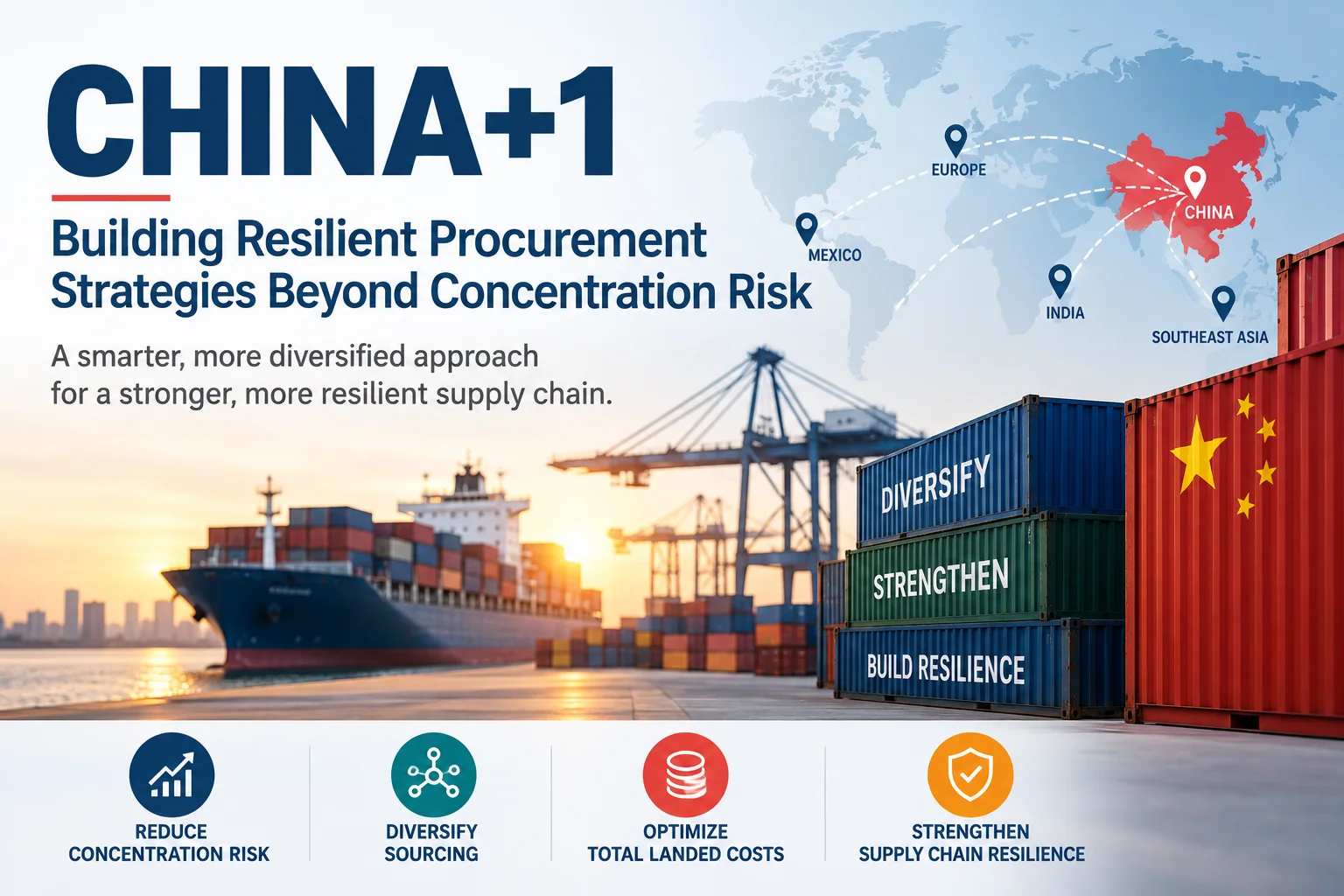
China+1 has become a mainstream strategy for multinationals trying to build real operational resilience into their supply chains. The core idea is simple enough, keep China as the dominant, core manufacturing and procurement base, while building out one or more supplementary production hubs in Southeast Asia, Mexico, or other emerging regions to handle overflow and reduce concentration risk.
It’s worth being precise here, because China+1 gets conflated with full relocation or some kind of “de-Chinalization” way too often. In practice, most companies still lean heavily on China for advanced manufacturing, supplier depth, engineering responsiveness, and sheer operational efficiency, while quietly building capacity elsewhere alongside it. Companies that treat China+1 as basically a low-cost relocation exercise tend to run into quality instability, qualification cycles that drag on far longer than planned, hidden costs that only show up months in, and resilience gains that never really materialize. The better approach treats China+1 as a category-specific operating model, not a blanket relocation mandate.
Why This Is Happening Now
Two forces are really driving how procurement organizations are rethinking their cross-border sourcing footprints.
The first is China’s own manufacturing cost base creeping up gradually over time. Labor, land, energy, and compliance costs have all risen, which has chipped away at the cost advantage that used to make certain labor-intensive, low-value manufacturing activities an easy call to keep in China. That’s pushing multinationals to genuinely evaluate whether specific standardized production activities make more sense elsewhere now, purely on cost and capacity grounds.
The second is a much sharper focus on resilience itself. The last several years have made the operational cost of regional disruption, logistics bottlenecks, and tariff volatility impossible to ignore. Procurement teams are responding by building dual- or multi-location sourcing structures that keep China’s real strengths intact while adding qualified alternative capacity somewhere else, so a single region’s problems don’t become the whole supply chain’s problem.
The pattern that’s emerging from all this is pretty differentiated. High-precision, technology-intensive components tend to stay anchored in China. Lower-complexity, standardized categories are the ones actually suited to gradual deployment elsewhere.
What This Looks Like By Industry
The impact of China+1 varies enormously by industry, and the differences come down to technical barriers, how mature the process is, how interdependent the supplier base is, and how demanding the qualification requirements are. A couple of industries make the pattern pretty clear.
Automotive tells a cautionary story. Tesla officially confirmed in May 2026 that it would not move forward with a manufacturing facility in India after years of on-and-off negotiation over market entry, tariff treatment, and local production requirements. The specific commercial reasoning behind any one company’s decision deserves some caution before drawing sweeping conclusions, but the broader China+1 lesson holds regardless, high-complexity automotive localization needs a lot more than cheap labor and a big addressable market. It needs a mature supplier ecosystem, local engineering support, qualified upstream materials, and a ramp-up environment that can actually be trusted.
That’s really an ecosystem gap more than anything else. Shanghai’s EV manufacturing success owes a lot to the Yangtze River Delta’s dense industrial network, where suppliers, tooling resources, engineering talent, and logistics infrastructure all sit within a short response radius of each other. India’s EV supply chain, by comparison, is still building out its capacity in batteries, power electronics, automotive-grade semiconductors, and upstream materials. The takeaway for procurement teams is straightforward, EV core systems need mature, clustered ecosystems, not just an attractive labor cost.
The underlying technology barriers reinforce the same point. Leading Chinese battery suppliers like CATL and BYD still hold real scale, technology, and cost advantages globally. Power semiconductor packaging and manufacturing capacity for advanced modules remains unevenly distributed, even with strong global players like STMicroelectronics and Infineon in the mix. Automotive-grade semiconductor qualification standards and local production capability remain genuine constraints for newer manufacturing locations. And the availability of cathodes, separators, electrolytes, and other battery materials keeps being a real determining factor in whether localized EV production can actually scale.
Consumer electronics tells a more layered story. Vietnam has become a genuinely important hub for global smartphone and electronics assembly, but final assembly moving offshore doesn’t mean the rest of the supply chain follows. A lot of the high-value components, process know-how, and precision manufacturing capability behind those products are still supported by established supplier networks in China and other mature manufacturing hubs. China+1 often ends up working as a layered model in practice, assembly, components, engineering support, and technology ownership spread across different geographies rather than moving together as a block.
For original design manufacturers and electronics suppliers, expanding overseas usually depends on transferring process expertise, tooling knowledge, production standards, and engineering support out from established manufacturing bases. China frequently stays the technical and operational anchor in these setups, while the overseas site adds capacity, regional proximity, or tariff and logistics flexibility on top.
The pattern across both industries is consistent, categories with higher technical complexity, tighter supplier interdependencies, and tougher qualification requirements just aren’t good candidates for rapid relocation. Standardized, lower-complexity categories are the ones that actually work for phased China+1 implementation.
What This Means Strategically
China+1 works best as a model for building genuine supply chain optionality while keeping the operational benefits of China’s industrial base intact. For a lot of high-complexity categories, fully decoupling from China’s supplier ecosystem just isn’t commercially or operationally realistic right now. The real objective should be reducing concentration risk without weakening supply continuity, quality assurance, or technical execution along the way.
That points to a practical challenge for procurement organizations, this requires redesigning sourcing governance itself, not just moving suppliers from one country to another.
A few principles tend to separate the programs that actually work from the ones that stumble. Upfront specification validation matters more than most teams expect, since domestic Chinese sourcing relies on a mature ecosystem that can directly produce finalized specifications with stable quality, but cross-border diversification requires genuinely validating drawings, tolerances, and technical parameters before committing. A lot of overseas supplier quotation gaps and qualification rejections trace back not to insufficient factory capacity, but to over-specified, China-centric design standards that simply don’t match local production conditions. Regional feasibility alignment matters too, differences in equipment capability, process maturity, workforce experience, and quality systems can meaningfully affect both performance and cost, so procurement, engineering, and quality teams need to jointly sort out which requirements genuinely must stay global and which can be adapted locally without hurting product performance. And total landed cost governance has to replace ex-factory pricing as the real decision basis, factoring in transportation, tariffs, inventory, quality performance, supplier management effort, and business continuity risk together rather than chasing the lowest quoted unit price.
Where China+1 Programs Actually Go Wrong
A handful of recurring pitfalls keep undermining otherwise well-intentioned China+1 programs. Treating it primarily as a cost-reduction exercise instead of a genuine resilience strategy is probably the most common one. Right behind that is replicating China-based specifications without actually validating whether they’re manufacturable somewhere else.
Comparing suppliers purely on unit price rather than risk-adjusted total landed cost is another frequent trap, along with shifting significant volume before supplier qualification and operational stabilization are genuinely complete. And underestimating how much a program still depends on Chinese materials, tooling, engineering support, and technical know-how, even after diversification, tends to catch teams off guard later.
Managing these risks well is really the difference between a China+1 program that delivers real resilience and one that just adds cost and complexity without much to show for it.
Matching Category Complexity to the Right Sourcing Model
The effectiveness of China+1 ultimately comes down to making category-specific sourcing decisions rather than pursuing broad relocation for its own sake. Procurement leaders need to assess each category on its own terms, technical complexity, how mature the supplier ecosystem is, qualification requirements, logistics exposure, and risk-adjusted total landed cost, before deciding where the China and +1 balance should actually sit.
Not every category deserves the same treatment. Selected standardized, lower-complexity categories can genuinely benefit from alternative sourcing locations. A lot of technology-intensive, tightly interconnected supply chains are still going to depend on China’s mature industrial ecosystem for the foreseeable future, and pretending otherwise doesn’t make the dependency go away, it just hides it until something goes wrong.
China+1 was never really about leaving China. It’s about reducing concentration risk through a more resilient, genuinely diversified, category-specific procurement model. Organizations that manage to balance China’s real manufacturing strengths against carefully qualified alternative capacity are the ones that end up better positioned to keep supply continuity intact, manage uncertainty as it comes, and build procurement resilience that actually holds up over the long run.
