


Where Customer Experience Really Begins
Every business sits on valuable insight. Not every business gets that insight across.
In research-driven B2B fields like investment research, business development, and knowledge process work, customer experience rarely comes down to a single delightful moment. It’s built interaction by interaction, through everything that helps a client understand a complex idea, trust the work behind it, and move forward with a decision.
An investor deck, a due diligence report, a market brief, and a proposal. Design shapes how all of these land. It turns raw data into something a reader can actually use, cuts through complexity, and keeps the story consistent no matter who’s reading it or where they sit in the organization.
AI is now part of nearly every design workflow, and that’s changed what designers spend their time on, not whether they’re needed. It handles the repetitive groundwork and speeds up execution, which frees people up to focus on the harder part: turning dense business content into something clear, consistent, and genuinely easy to act on.
The future of B2B customer experience won’t be decided by AI on its own. It will come down to how well organizations pair smart technology with design expertise to turn what they know into communication that actually lands.
 How B2B Customer Experience Gets Shaped
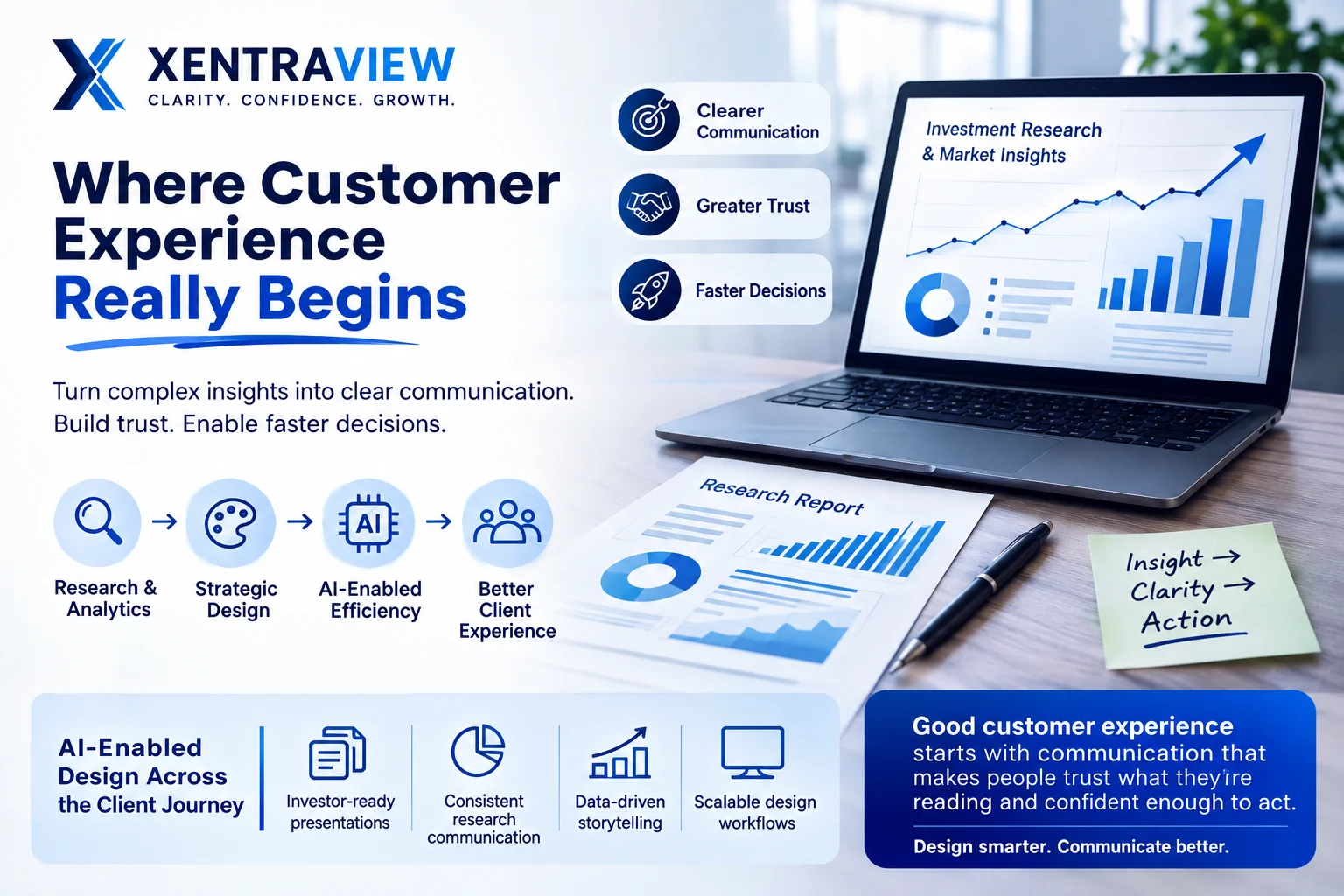 How B2B Customer Experience Gets Shaped
In research-heavy B2B settings, customer experience goes well past delivering the final product or report. It’s built through every interaction that helps a client understand the work, trust it, and act on it with confidence.
Consumer experience tends to chase convenience or an emotional hook. B2B is different. It’s shaped by how consistent and how sharp the interactions are across a much longer buying journey. The person on the other end might be a senior investor weighing a major allocation, a client committee reviewing a set of recommendations, or an internal team trying to align on next steps. Each of them meets the work through a different format, and each one is quietly building trust in the expertise behind it.
That journey has also gotten a lot more scattered. McKinsey’s 2026 Global B2B Pulse Survey, based on responses from nearly 4,000 decision-makers across 13 countries, found that buyers now interact across an average of ten channels over the course of a purchase, and they expect that experience to feel seamless as they move between them. That means a proposal, a report, a dashboard, an email, and a follow-up call, all of it adds up to one impression of the organization behind it, not several.
Customer experience in this world gets built across places like:
- Investor decks and client proposals
- Research reports, dashboards, and data visualizations
- Leadership updates, newsletters, and outreach communications
- Digital assets, campaign materials, and presentation content
Across every one of these, design does the quiet, essential work. It organizes information, sets a visual hierarchy, and makes dense material easier to absorb, without touching the substance of what’s actually being said.
Paula Scher, the designer, put it simply: design is intelligence made visible. In B2B research and advisory work, that’s really the job. Make the expertise visible, make it clear, make it consistent, and the trust tends to follow.
The Real Challenge: Turning Complexity Into Something Usable
As firms produce more research, more data, and more analysis, getting that information across clearly has only gotten harder. The goal was never just to produce a report or a deck. It’s to make sure every piece of communication helps someone decide faster. Research published in the International Journal of Human-Computer Interaction has pointed to something most of us already feel: too much unstructured information slows people down, makes decisions harder to reach, and eventually dulls original thinking.
An investor presentation has to compress months of research into something a decision-maker can act on in minutes. Reports, dashboards, and outreach materials have to hold analytical depth while staying easy to follow across different regions and audiences.
The issue was never the quality of the underlying work. It’s making sure that work reaches people in a form they can actually use. That’s where design earns its place, not as decoration, but as the thing that organizes the information, sets the hierarchy, and keeps everything consistent enough that the reader can focus on the insight instead of the formatting around it.
Where AI Fits Into Design
AI is letting design teams move faster by taking repetitive production work off their plate, which leaves more room for the things that actually need a human eye: clarity, consistency, and how the piece feels to read.
In practice, that looks like:
- Turning dense research and technical findings into presentations that are ready for a decision-maker’s desk.
- Adjusting the same core content for different industries, regions, and audiences without starting from scratch each time.
- Suggesting layouts and structures that make a report or deck easier to scan and easier to remember.
The idea that design is a system, not just a look, has been around in design thinking for a while now, and AI is what’s finally making that system move at the speed research teams need. It gives designers the ability to deliver work that’s faster to produce, easier to take in, and consistent everywhere a client encounters it.
AI-Enabled Design Across the Client Journey
Rather than replacing what a design team brings to the table, AI changes how fast and how far that expertise can scale. Paired with intelligent automation, strategic design lets an organization put out high-quality materials more consistently, without losing the clarity or brand consistency that took years to build.
From Information to Impact: What This Looks Like in Practice
A mid-sized investment research firm came to XentraView with a familiar problem. The underlying research was sound, the analysis held up, but the way it reached clients wasn’t landing the way it should have. Reports were dense, decks varied wildly from one analyst to the next, and clients were spending more time trying to parse the format than absorbing the actual findings.
One line from the engagement stuck with the team: the work is strong, but nobody outside the room can tell.
XentraView’s design and research teams worked through the material together. They rebuilt the firm’s research reports into a format that led with the decision-relevant findings first, standardized how charts and data visualizations were built so every analyst’s output looked and read the same way, and brought in short motion graphics to walk clients through frameworks that used to take a page of dense text to explain. Investor updates and outreach emails got pulled under one visual identity instead of looking like they came from five different teams.
The change showed up quickly. Clients moved through reports faster, meetings spent less time on clarification and more on the actual decision, and the firm’s outreach started reading as one consistent voice instead of a patchwork.
Where B2B Customer Experience Is Headed
Buying journeys aren’t getting simpler, and organizations will increasingly be judged as much on how they communicate their expertise as on the expertise itself. Every deck, every report, every dashboard, every follow-up message adds to how a client reads an organization’s credibility and how confidently they act on what they’re told.
Strategic design isn’t going anywhere in that picture. If anything, it’s the thing that lets clarity and consistency survive contact with a longer, messier, more channel-heavy buying journey.
A sharp first impression gets someone’s attention. Clarity and consistency are what keep them around.
Let’s Build This Together
If your research drives client decisions, the way you communicate it should make those decisions easier to reach, not harder. At XentraView, we bring strategic design and AI-enabled workflows together to help organizations build:
- Investor-ready presentations that hold up under real scrutiny.
- Research communication that stays consistent across every team and region.
- Data-driven storytelling that makes dense findings genuinely usable.
- Design workflows that scale without losing quality as volume grows.
A good customer experience in this space was never really about the deliverable. It starts with communication that makes people trust what they’re reading and confident enough to act on it.
