


Most conversations about AI in investment banking start in the wrong place. Someone asks which platform is best, which model to license, and which vendor to sign with, and the whole discussion gets stuck there before anyone has actually figured out what the AI is supposed to be doing. That question, what tool is best, doesn’t mean much until you know exactly what you’re trying to make it good at.
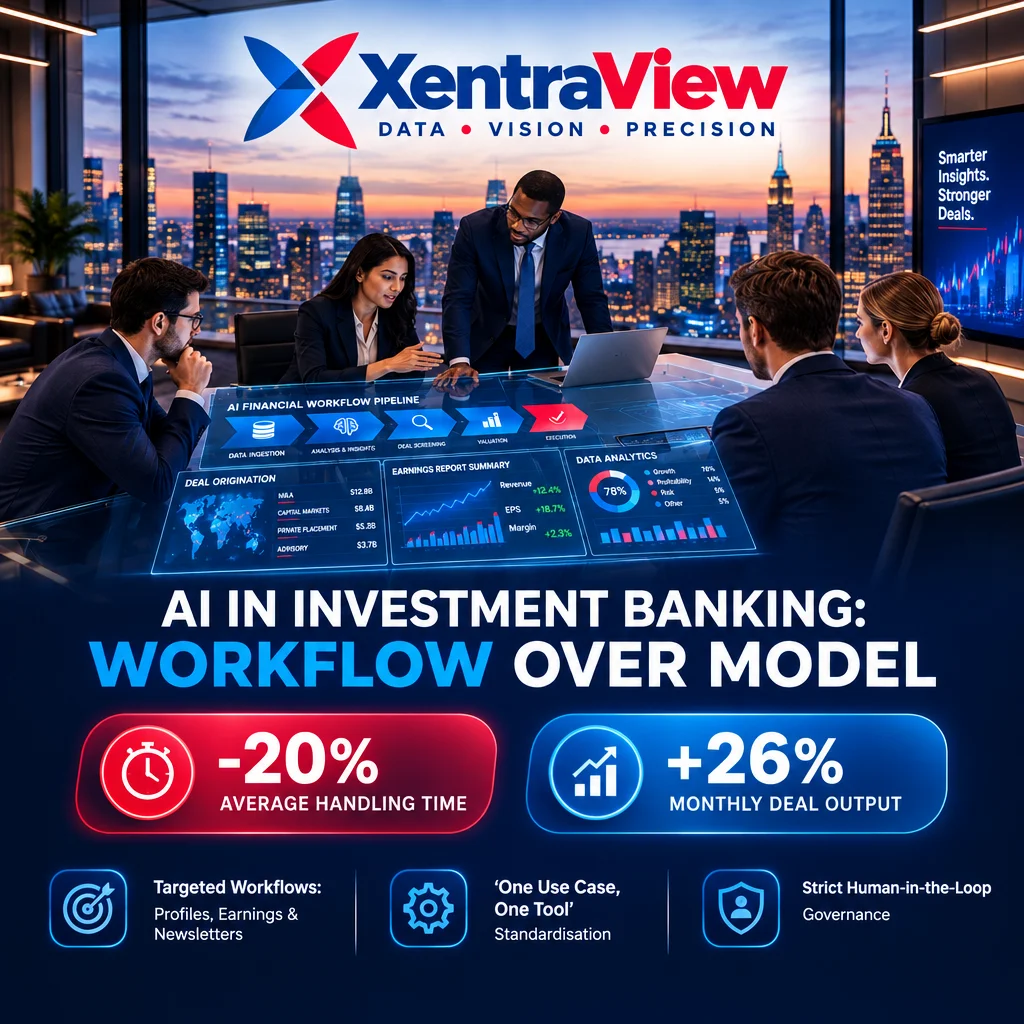
We ran into this directly while working with a bulge bracket bank on their deal origination process. Rather than starting from a platform shortlist, we set that question aside entirely and mapped out every step in the workflow instead, looking for the ones that were high-volume, time-sensitive, and repeatable enough that AI could actually handle them well. That exercise narrowed things down fast. Out of the whole workflow, three steps stood out: company profiles, earnings summaries, and newsletters. Not the entire pipeline, just those three. We deployed AI there, built governance around what it produced, and tracked the results closely. Average handling time dropped 20%. Monthly output rose 26%, without adding a single new hire. And the capacity that freed up went straight back into covering more deals.
Here’s what we took away from that engagement, in five parts.
The Workflow Design Matters More Than the Model
The clearest lesson from this project is that success came down to workflow discipline, not which platform got chosen. Knowing exactly which steps to target mattered far more than picking a cutting-edge model. In fact, none of the heaviest, most sophisticated frontier models were needed here at all, lighter-weight models handled these tasks perfectly well. The model wasn’t what made this work. The plumbing underneath it was.
Plumbing is the kind of work nobody notices when it’s done right. Things just run, outputs come out clean, and the whole thing fades into the background of everyone’s day. You only notice it when something breaks. That’s really the standard AI should be held to inside a bank’s operations, quiet and reliable, which is exactly why the infrastructure sitting underneath the technology matters more than the technology sitting on top of it.
Not Every Task Deserves the Same Treatment
A big part of what made the workflow-first approach work was sorting tasks by how suited they actually were to AI in the first place. Which parts of the process genuinely belonged to a model, and which didn’t?
The tasks that were standardised and high-volume delivered the biggest wins, often producing efficiency gains somewhere between 25 and 40%. Tasks that leaned more on judgment, industry analysis being a good example, benefited from AI as a support layer rather than a full handoff. And the work that was almost entirely judgment-driven, financial modelling, and pitchbook storylining stayed with the people who’d always done it. This wasn’t AI applied everywhere uniformly because it could be. It was AI placed deliberately where it would actually move the needle.
Standardisation Is What Lets This Scale
One decision that mattered as much as any technical choice was resisting the urge to let every team experiment with its own tools. The bank went with a “one use case, one tool” approach instead, testing a few options for each workflow, picking the one that performed best, and then deploying that consistently across the board rather than letting five slightly different versions of the same tool proliferate.
That single choice avoided what’s sometimes called agent sprawl, a mess of disconnected tools each doing something slightly different, none of them talking to each other, and none of them adding up to real enterprise-wide value. Standardising the tools, the prompts, and the processes meant the outputs stayed consistent, measurable, and something the team could actually improve on over time rather than starting from scratch with every new use case.
Governance Isn’t an Afterthought, It’s the Foundation
Given what’s actually at stake in investment banking deliverables, none of this would have worked without governance built in from day one. Every output that came out of the AI system went through strict controls, human review, versioned prompts, and full traceability back to source. That governance wasn’t bolted on after the fact to fix problems, it was there from the start, which meant that as output scaled up, quality and compliance never had to be sacrificed to get there. That’s really what let the bank scale AI with any real confidence.
Ownership Is What Turns Capability Into Results
The last piece, and one that’s easy to overlook, was clear accountability for what the AI actually produced. This wasn’t a case of handing analysts a tool and hoping for the best. Specific teams owned the validation and final delivery of every output, which meant AI use never turned into AI adoption for its own sake. That shift, from simply using a tool to actually owning the outcome it produced, is what turned faster processing into real business results: shorter turnaround times, higher throughput, and more productive teams overall.
What This Adds Up To
The experience with this bank makes a fairly simple point, but one worth repeating: the hard part of AI adoption was never really the technology. It’s how you deploy it. The banks that get real value out of this will be the ones willing to be disciplined about it, picking the right workflows deliberately, embedding AI into processes that are actually standardised, holding governance as a non-negotiable, and scaling through consistency rather than enthusiasm.
At XentraView, this is more or less the philosophy we bring into every engagement like this one. The tools a bank chooses matter less than most people assume. What actually produces sustainable, compounding results is how well those tools get built into the way work actually gets done.
