


The asset management industry is going through one of those stretches where several separate trends start bleeding into each other, and it gets harder by the month to talk about any one of them in isolation. ETF growth, AI adoption, data modernization, digital assets, and private markets, none of these are new conversations on their own. What’s changed is how tightly they’re now wound together and how much that’s starting to reshape what firms actually need to get right operationally.
ETFs Are Still the Growth Story, But the Ecosystem Behind Them Has Changed
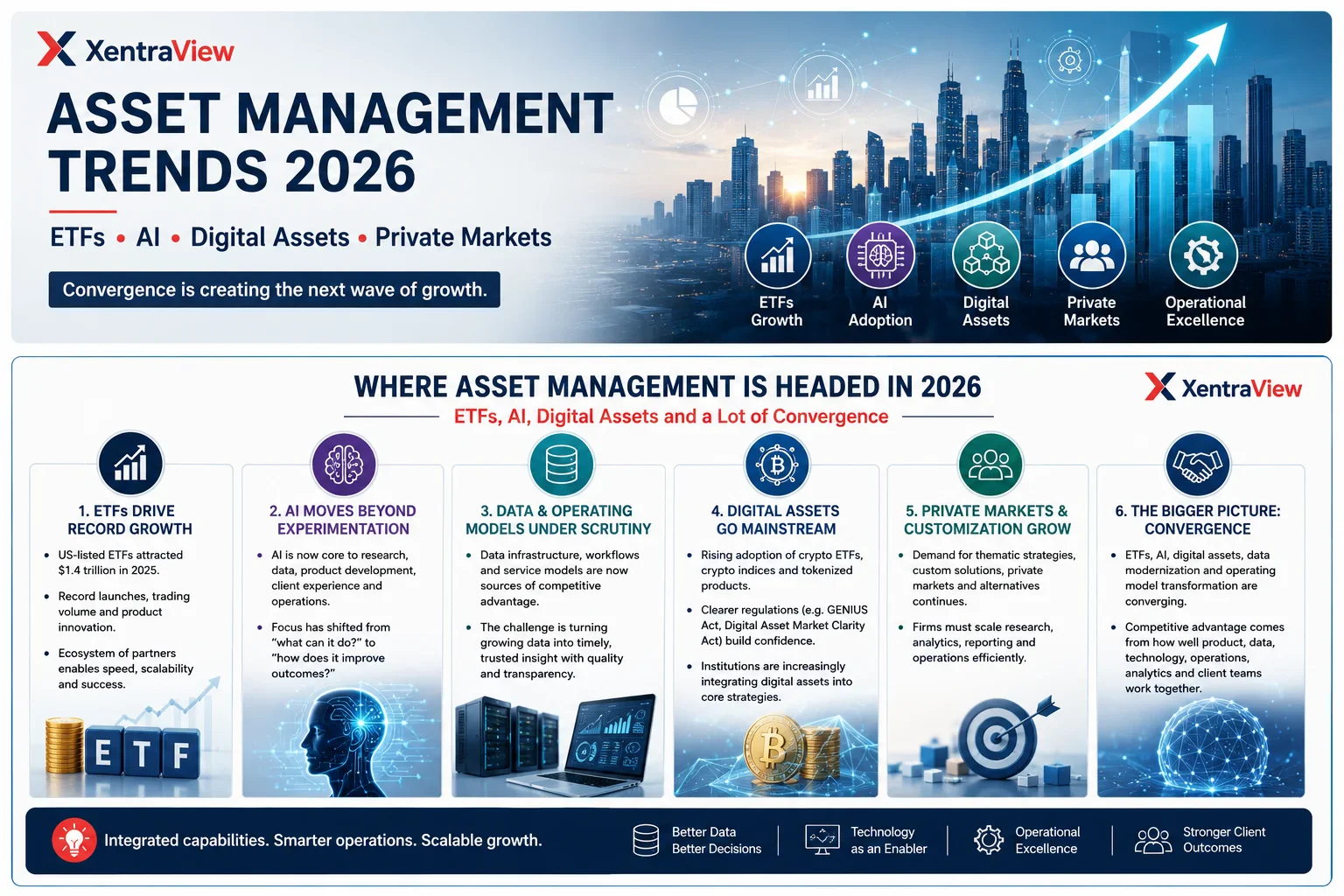
ETFs had a genuinely record year. US-listed funds pulled in $1.4 trillion in 2025, the biggest annual haul on record, with launches and trading volume both hitting new highs at the same time, something that hasn’t happened simultaneously since 2021. New launches have kept up that pace into 2026 too, with product counts surging past 370 this year alone, and issuers are slicing exposures more finely than ever, memory chips, AI power infrastructure, rare earths, whatever the next narrow theme turns out to be.
What’s easy to miss underneath all that volume is how collaborative the ETF ecosystem has become to actually pull off. Most successful launches now lean on a whole network of partners, index providers, technology vendors, analytics teams, operations support, and product infrastructure specialists, working together rather than one firm doing everything in-house. As competition for shelf space intensifies, speed to market and operational scalability matter just about as much as the underlying product idea. A great fund idea that takes nine months to actually launch loses to a decent idea that ships in six.
 Functions That Used to Be Separate Aren’t Anymore
 Functions That Used to Be Separate Aren’t Anymore
Product development, data management, operations, technology, analytics, and client servicing- these used to get evaluated as their own silos. That’s breaking down. Firms aren’t asking “is our data team good” and “is our tech team good” as separate questions anymore. They’re asking how well those pieces actually work together, because that’s increasingly what determines whether a new product or capability gets to market on time and stays profitable once it’s there.
This shows up most clearly in ETF launches, where getting a product out the door cleanly now depends on data, analytics, technology, operations, distribution, and client support all moving in sync rather than handing work off between departments that barely talk to each other. More broadly, the direction of travel is away from optimizing individual functions and toward building genuinely integrated operating models that can support growth without adding a proportional amount of headcount and complexity every time volume goes up.
AI Has Moved Well Past the Pilot Stage
The tone around AI in asset management has shifted noticeably over the past year or so. Nobody’s really talking about experimentation for its own sake anymore. Financial services is one of the industries expected to see the most concrete benefit from AI adoption going into 2026, and the conversation inside firms has moved from “what can this do” to “how does this actually move a number we care about?” Investment research, data management, product development timelines, client experience, and operating model transformation- AI is getting pulled into all of it, less as a novelty and more as infrastructure.
Data and Operating Models Are Getting Real Scrutiny
As products get more sophisticated and the volume of data underneath them keeps climbing, a lot of firms are genuinely rethinking how their operating models need to change. Modernizing data infrastructure, tightening up operational workflows, and building more scalable service models- these have stopped being back-office housekeeping items and started being treated as actual sources of competitive advantage.
The bottleneck isn’t access to data anymore, honestly. Most firms have plenty of it. The real challenge is turning growing volumes of raw data into timely, trustworthy insight without losing control, quality, or transparency somewhere along the way. That’s a much harder problem than just buying more storage or hiring another data team, and it’s where a lot of firms are currently getting stuck.
Digital Assets Keep Working Their Way Into the Mainstream
Interest in digital assets, crypto ETFs, crypto indices, and tokenized investment products remains strong, even if adoption still varies a lot firm to firm. Clearer regulatory guidance, including legislation like the GENIUS Act and the Digital Asset Market Clarity Act, has given asset managers more confidence to actually integrate digital assets into portfolios and operations rather than treating them as a side experiment. There’s a growing recognition industry-wide that these products are becoming part of the core investment landscape rather than a niche curiosity, particularly as institutional participation keeps climbing.
Private Markets and Customization Aren’t Slowing Down Either
Investors keep pushing for more tailored solutions and more differentiated sources of return, and managers are responding by leaning harder into thematic strategies, customized products, private markets, and alternatives more broadly. The catch is that firms need to scale research, analytics, reporting, and operations to support all of this without complexity growing at the same pace, which is a genuinely difficult balance to strike. Technology, better data infrastructure, and more flexible operating models are turning out to be the actual enablers of that growth, not just nice things to have alongside it.
Where XentraView Sees the Opportunity
The biggest shift worth paying attention to right now is the ETF ecosystem’s growing appetite for specialist partners. New entrants and established managers alike are increasingly relying on outside expertise to bring products to market efficiently rather than trying to build every capability in-house, and that’s a real opening for firms that can combine research depth with operational and analytical support.
Digital assets look like a genuinely compelling adjacent opportunity too. As institutional adoption of crypto indices, crypto ETFs, and tokenized products keeps maturing, the need for trusted data, rigorous analytics, and dependable operational support is only going to grow alongside it.
The Bigger Picture
No single trend here is really the headline. It’s the convergence of all of them at once. ETFs, AI, digital assets, data modernization, and operating model transformation aren’t separate conversations happening in parallel anymore, they’re reshaping, together, how investment firms build products, serve clients, and scale for whatever comes next.
At the same time, the old boundaries between product, data, technology, operations, analytics, and client-facing teams keep breaking down. Competitive advantage increasingly comes down to how well these pieces work together, not how strong any single one of them is on its own. For firms trying to figure out where to focus next, that’s probably the most useful signal in the room right now.
