


Trending Themes in Asset and Wealth Management
This month’s Market Pulse from XentraView looks at what’s actually moving in asset and wealth management right now, not the headlines everyone’s already seen, but the stuff underneath them.
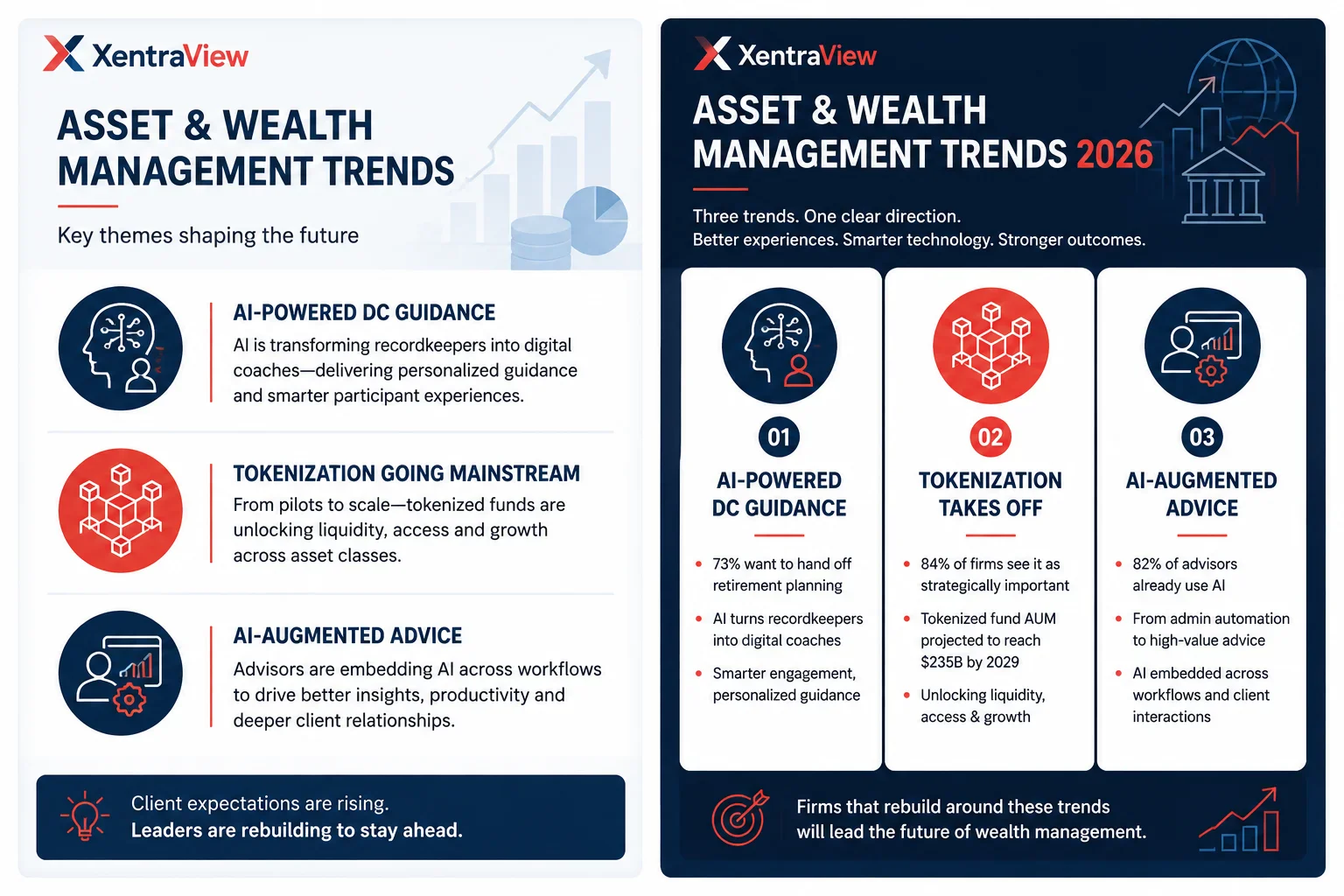
Three themes stood out this time around. AI is turning DC recordkeepers from back-office administrators into something closer to a guidance layer for participants. Tokenization has quietly left the pilot-program stage and is starting to look like a real growth lever. And advisors are folding AI directly into their workflow now, not just using it to shave a few minutes off admin work here and there.
Put those three together and you get the same underlying story told three different ways: client expectations are outrunning most firms’ operating models, and the firms actually winning right now are the ones rebuilding around that instead of bolting AI onto whatever they already had running.
 From Recordkeepers to Digital Coaches: How AI Is Redefining the DC Participant Experience
 From Recordkeepers to Digital Coaches: How AI Is Redefining the DC Participant Experience
Defined contribution recordkeeping spent decades being almost entirely transactional. Log in, check a balance, and maybe bump a contribution rate up a percent. That’s shifting, and it’s shifting fast. AI is turning these platforms into something that can actually engage a participant instead of just processing what they type in.
The appetite for this is bigger than most people realize. JP Morgan’s 2026 DC Plan Participant Survey found that 73% of participants wish they could just hand off retirement planning and investing entirely, and 86% of Gen Z participants think their employer owes them at least some help saving for retirement. That’s not a small data point buried in a survey. That’s an entire generation telling recordkeepers, more or less directly, what they want built.
A few things are converging to make this move faster than it might have a few years ago. Participants themselves are getting more comfortable with the idea. Invesco’s Winter 2026 DC Participant Pulse Survey found just over half are already using AI tools for financial planning or investment decisions, though trust in fully autonomous selection still trails well behind trust in AI paired with a human reviewing it. Plan sponsors see the upside too, T. Rowe Price’s 2026 U.S. Retirement Market Outlook found roughly two-thirds see real value in AI-powered assistants fielding common plan questions. And a lot of the industry is still running on legacy recordkeeping infrastructure, which is honestly part of why there’s so much room here for AI to make a visible difference rather than a marginal one.
Providers aren’t sitting on their hands. Corporate Insight’s May review put Fidelity and Voya ahead of the pack on virtual assistant capabilities, particularly around in-chat account access and actually handling transactions rather than just answering questions about them. Vestwell reported that AI agents now field the large majority of inbound participant inquiries, across roughly twenty languages, which is a genuinely different scale of servicing than most recordkeepers could pull off manually. Betterment introduced an account recommender that blends advisor-built logic with AI-generated explanations and fiduciary guardrails baked in. RPAG launched a tool giving retirement plan advisors contextual, AI-assisted answers in the middle of a workflow instead of forcing them to go dig through documentation.
Where XentraView sees this going: the thing that separates one recordkeeper from another isn’t going to be operational efficiency for much longer. It’s going to be whether participants actually trust the guidance they’re getting. That means building AI governance and explainability into vendor due diligence from the start, not adding it later once something’s already gone wrong. It means using AI to support the human judgment involved in high-stakes retirement decisions rather than trying to replace it outright. And it means genuinely redesigning education and servicing workflows around AI-enabled delivery, not just dropping a chatbot on top of a process that was built for a different era.
Tokenization: Moving from Experimentation to Competitive Advantage for Asset Managers
Tokenization has quietly moved past the point where anyone can still call it experimental. What used to be a blockchain curiosity is turning into an actual strategic priority, and the numbers back that up pretty clearly. Broadridge’s Tokenization Pulse survey found 84% of financial institutions now consider tokenization strategically important, and momentum in the fund industry specifically is even stronger, with 80% of financial services firms expecting widespread adoption of tokenized funds within five years.
The scale here is genuinely hard to overstate. Calastone’s research projects tokenized fund AUM growing from $4 billion in 2024 to $235 billion by 2029, a nearly sixtyfold jump, driven by a mix of institutional adoption and real demand from the DeFi side of the market for treasury-grade, tokenized cash instruments.
Why the interest? Better liquidity, fractional ownership that opens products to investor segments that couldn’t access them before, and an overall smoother investor experience, all supported by blockchain infrastructure that’s finally mature enough to actually deliver on it. This isn’t happening in a vacuum either.
The moves being made are no longer experimental in any meaningful sense. BlackRock’s BUIDL fund is sitting close to three billion dollars in tokenized assets across Ethereum, Avalanche, and Solana, and the firm has already filed for two more tokenized products plus on-chain shares tied to a separate multibillion-dollar money market fund. Hamilton Lane expanded investor access to its tokenized Senior Credit Opportunities Fund through a blockchain-based feeder structure back in June. JPMorgan Asset Management launched a tokenized money market fund on Ethereum in May, working alongside Anchorage Digital to help support institutional adoption.
Where XentraView sees this going: for asset managers still on the sidelines, the smart move is starting with the lower-risk entry point, money market and short-duration fixed-income products, where adoption already has real traction rather than theoretical interest. Nobody needs to build every capability alone either, partnerships with tokenization platforms, custodians, and blockchain infrastructure providers will get most firms to market faster than trying to do it entirely in-house. And the investment that actually matters long-term isn’t just the technology, it’s the people and governance sitting behind it.
Beyond Productivity: AI-Augmented Advice Reshaping Advisor Workflows in Wealth Management
AI in wealth management has stopped being a nice productivity add-on. It’s turning into something closer to a strategic layer running underneath how advisors actually do their jobs day to day. A survey from Edward Jones and Morning Consult found 82% of financial advisors are already using AI, and just over half see it as freeing them up for the higher-value client conversations that actually matter. Client conversations are shifting in a related way too, more investors are now showing up having already run an advisor’s thinking against AI-generated research of their own before the meeting even starts.
The pressure driving this is coming from two directions at once. Capgemini’s World Wealth Report 2026 found that only 17% of high-net-worth individuals describe their advisory experience as genuinely seamless and personalized, which leaves an enormous gap for AI-enabled tools to actually close. On the advisor side, 76% say they want AI to take routine tasks off their plate entirely so they can spend that time on real client engagement instead. And the time crunch behind all of this is real, Deloitte estimates advisors currently lose close to 70% of their time to administrative and operational work, with agentic AI potentially unlocking meaningful productivity gains as adoption matures over the coming years.
The moves here are concrete, not aspirational. Rockefeller Capital Management partnered with Anthropic in June to build an AI-enabled wealth management platform on Claude, starting with client meeting intelligence, operational workflows, and internal support. Morgan Stanley announced plans to give corporate clients’ AI agents direct access to its stock-plan administration platforms, which is a real signal that agent-driven servicing is being taken seriously rather than treated as a gimmick. RightCapital launched an AI planning agent that can interpret client information, flag planning anomalies, and run retirement simulations directly inside an advisor’s existing workflow.
Where XentraView sees this going: the direction of travel is pretty clear at this point, AI is moving from isolated use cases toward something embedded across the whole advisory process. Firms should be thinking about capacity as much as efficiency, AI-enabled workflows can help serve more clients with real personalization without scaling headcount at the same rate. The shift from insight to execution is only going to accelerate, the next phase isn’t AI surfacing recommendations, it’s AI actually carrying out planning, servicing, and engagement tasks that used to eat up an advisor’s whole day. And this really is an enterprise question rather than a tooling one, firms embedding AI consistently across the value chain, instead of in scattered pockets here and there, are the ones most likely to see it actually show up in client retention.
