


Model portfolios have quietly become one of the central battlegrounds in asset management. As firms move away from picking individual securities one by one and toward centrally managed, packaged models, the shift is doing more than making things more efficient. It’s changing how asset managers actually differentiate themselves, how they get access to distribution, and how they deliver value to clients in the first place.
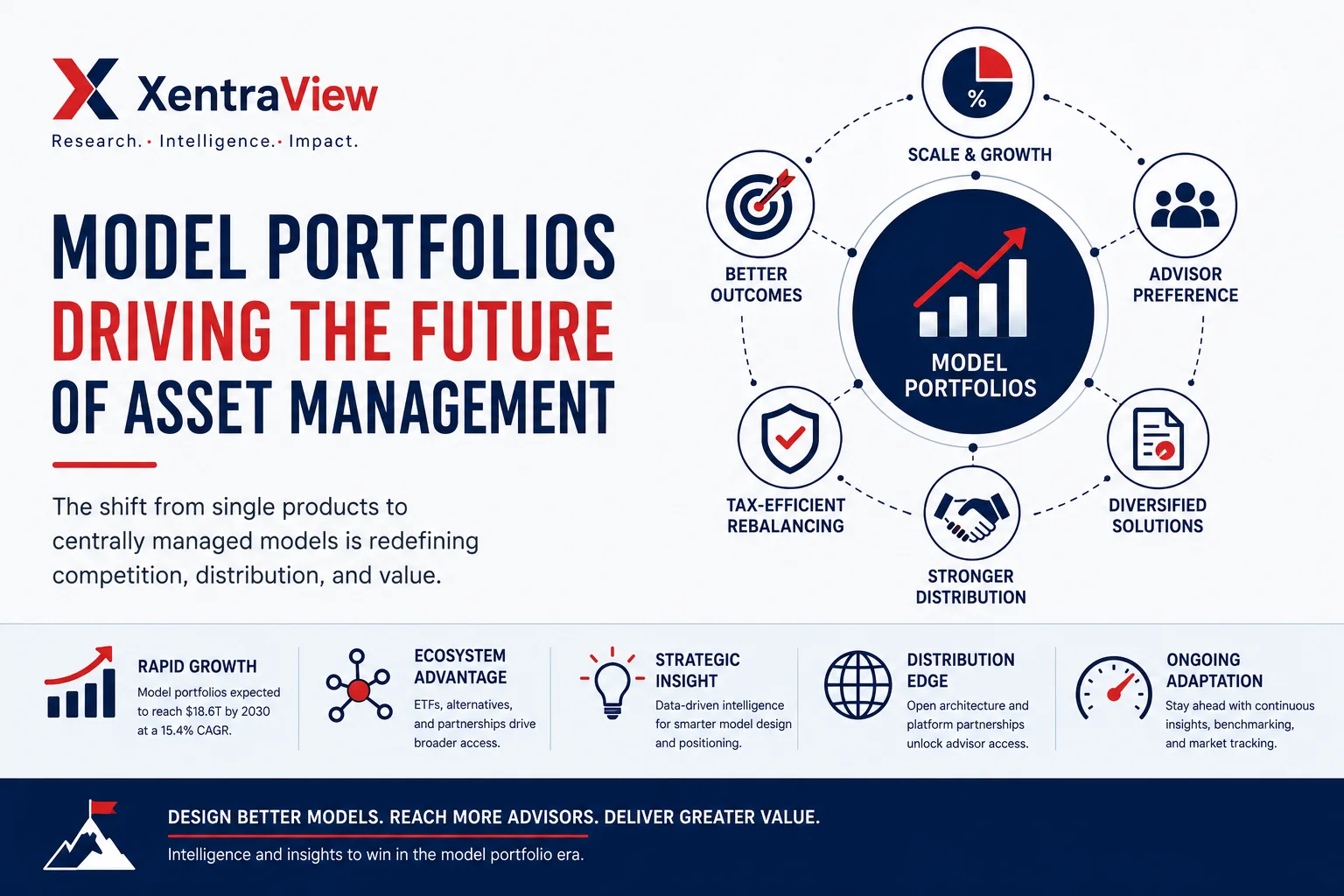
The scale here is hard to overstate. Broadridge data shows model portfolios closed out 2025 at $9.3 trillion in AUM, up 18% since 2020, and now account for roughly a third of all assets in retail intermediary channels. That share held steady into the first quarter of 2026 too. Broadridge expects the category to keep growing at around 15.4% annually, reaching $18.6 trillion by 2030. That’s not an emerging trend anymore. It’s already the dominant way a lot of firms are choosing to compete for growth.
A few structural features are making models even more attractive on top of the raw growth numbers. Tax-efficient rebalancing designed to optimize after-tax returns and broader access to alternatives for real diversification- these aren’t small conveniences; they’re becoming genuine selling points. Turnkey asset management platforms have made the whole thing easier to actually run too, offering centralized construction, rebalancing, reporting, and due diligence in one place. Increasingly, models aren’t just a product category. They’re becoming the main channel through which asset managers, advisors, and investors actually connect with each other.
 From Products to Portfolios: A Real Shift in How Managers Compete
 From Products to Portfolios: A Real Shift in How Managers Compete
For a long time, asset managers won by having strong standalone products and wide distribution. That’s getting harder to sustain on its own. Fee pressure on individual products keeps climbing, and advisors are demanding more holistic solutions instead of a shelf full of separate funds they have to stitch together themselves. Firms are responding by combining portfolio construction capability with deeper ecosystem partnerships, because that combination is turning out to be a lot more durable than product performance by itself.
A few dynamics are worth calling out specifically.
Models have become a distribution layer in their own right. ETFs sit at the core of most pre-built models now, and asset managers are increasingly using the model itself as the vehicle that directs capital toward other products and asset classes. That means getting included in a widely used model can matter just as much as how well a given fund actually performs, since inclusion has a direct line to advisor-driven flows.
Whoever builds and distributes the model effectively controls the asset allocation decision underneath it, and that’s a real structural advantage when it comes to capturing flows. This is intensifying competition among the largest players with strong fund ecosystems already in place, but it’s also cracking open real opportunities for smaller, more specialized managers who can earn a spot inside someone else’s model framework.
Open architecture keeps gaining ground over proprietary platforms too. RIAs and distribution platforms are asserting more control over what goes into client portfolios, and a lot of them are showing a clear preference for open architecture over closed, single-provider setups. That’s forcing asset managers to rethink distribution from the ground up, with a lot more emphasis on partnerships, interoperability, and simply having a strong enough presence across platforms to get noticed.
Where XentraView Fits Into This
Firms navigating the shift toward model portfolios need more than good investment ideas, they need a clear read on where the market is actually heading, how competitors are positioning themselves, and which distribution partners are worth pursuing. That’s the kind of work we spend most of our time on.
On the research and market intelligence side, we help asset managers understand advisor preferences, investor demand, and where the competitive landscape is actually moving so that model design decisions are grounded in real data rather than guesswork. We also do a fair amount of competitive benchmarking work, looking at how a firm’s model offerings, fee structures, and reported performance stack up against peers, and using that to surface real gaps worth pursuing rather than assumed ones.
Distribution strategy is another area where a lot of firms get stuck. Figuring out which TAMPs, custodial platforms, and distribution partners actually make sense for a given model, and then positioning that model to gain real traction inside advisor ecosystems, takes more than a list of platform names. It takes an understanding of how each platform’s advisors actually make decisions.
None of this is a one-time exercise either. Advisor preferences shift, platforms change their inclusion criteria, and competitors adjust their own model lineups constantly. The firms that stay ahead here tend to be the ones treating this as an ongoing discipline rather than something they revisit once a year when a report happens to land on someone’s desk.
Where This Is Heading
Model portfolios aren’t a passing trend anymore, they’re becoming the default way a large share of retail assets get managed, and that shift is only going to keep accelerating over the next few years. The firms that figure out how to design genuinely differentiated models, get them included in the right platforms, and keep adjusting as advisor and investor preferences evolve are the ones that are going to capture a disproportionate share of the growth still ahead in this space.
