


Ask anyone raising capital for a large development right now and they’ll tell you the same thing: investors want the economic case quantified, stress-tested, and explained clearly, and they want it faster than most teams are set up to deliver. Traditional Economic Impact Assessment has always been thorough, but thorough and fast rarely go together, especially once timelines tighten and investors start asking for three different funding scenarios by Friday. That gap is where agentic AI is starting to change things, not by speeding up individual tasks, but by rethinking how the whole EIA process runs from start to finish.
What “Agentic” Actually Means Here
It’s easy to lump this in with the general AI automation trend, but agentic EIA is a different animal. Rather than one tool doing one job in isolation, specialised agents handle distinct stages, data sourcing, multiplier modelling, and scenario testing, and they work in a coordinated sequence rather than as disconnected steps someone has to stitch together manually. Human validation still sits at the points that matter. The difference is that the workflow itself is structured and connected end to end, instead of a patchwork of automations that each save time individually but leave the joins to a person.
Put simply, traditional AI in EIA automates a task. Agentic AI orchestrates the whole workflow, connects the phases, runs multiple scenarios instead of a single static baseline, and manages the dependencies between steps automatically rather than requiring someone to manually carry outputs from one stage into the next.
What the End-to-End Workflow Looks Like
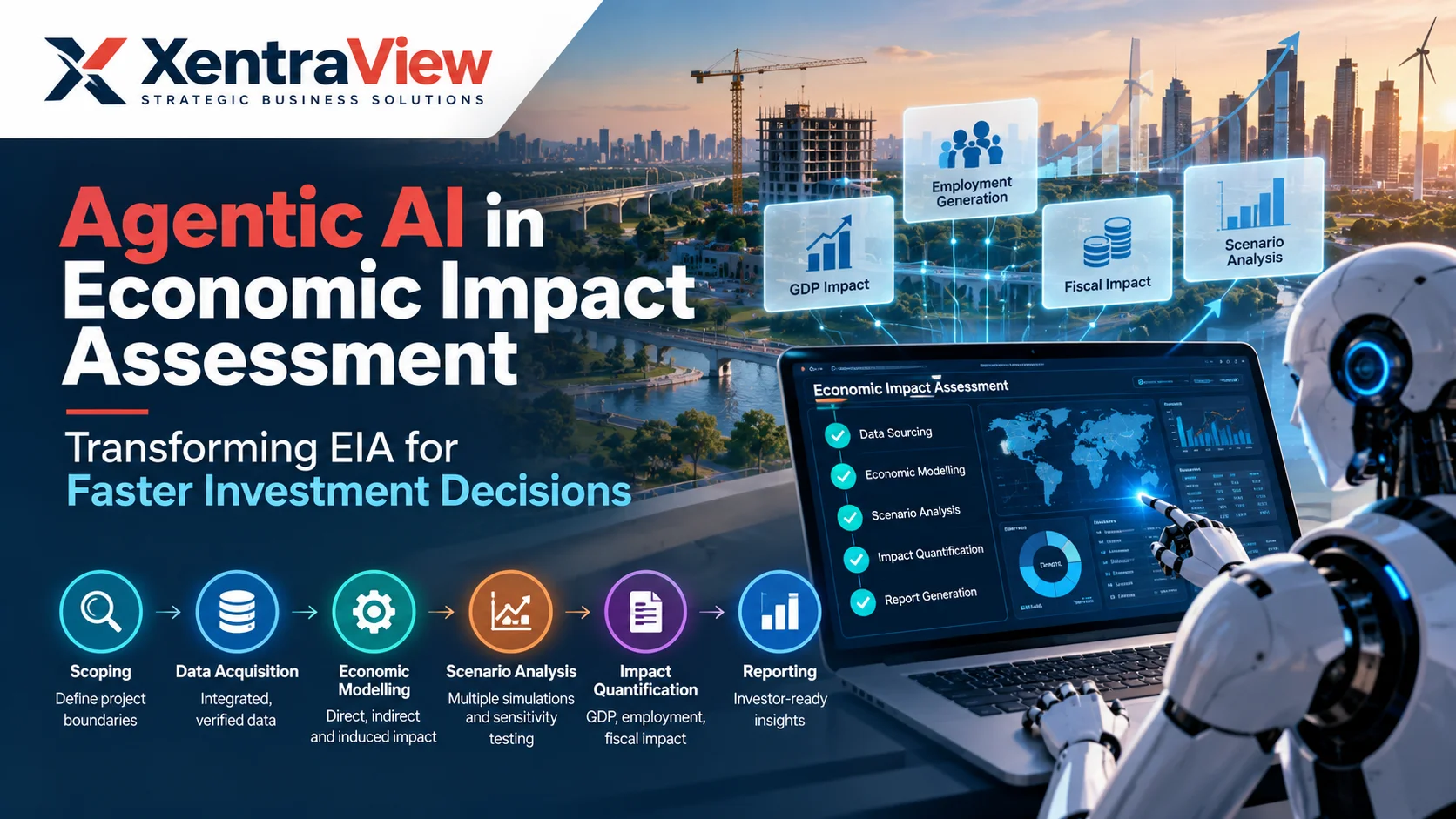
Gartner has projected that by the end of 2026, 40% of enterprise applications will carry task-specific AI agents embedded within them. EIA is following that same trajectory, and in practice, an agentic approach breaks the process into coordinated phases:
Scoping comes first, setting project boundaries, geography, sector, and the economic assumptions everything else rests on. Data acquisition follows, pulling macroeconomic data and sector benchmarks through integrated connectors and checking them for consistency before anything gets modelled. Economic modelling applies input-output frameworks to estimate direct, indirect, and induced impact. Scenario and sensitivity analysis runs multiple simulations, adjusting assumptions and testing which variables actually drive the outcome. Impact quantification produces the headline figures, GDP contribution, employment, and fiscal impact. Reporting turns all of that into something investors, governments, or boards can actually read and act on. And quality assurance runs throughout, keeping assumptions and calculations traceable at every checkpoint.
For anyone in a capital-raising conversation, that last part, traceability, matters as much as speed. Investors don’t just want an answer, they want to see how you got there.
Where This Actually Moves the Needle for Fundraising
The efficiency gains are real, but the more interesting shift is in how projects get evaluated and funded in the first place.
When an investor asks “what happens if construction slips six months” or “Show me the downside case,” a team running an agentic workflow can turn that around in near real time rather than sending an analyst back to rebuild a spreadsheet. That responsiveness alone changes the tenor of due diligence conversations. Structured, traceable assumptions also tend to build more trust during that process, since investors can see the logic rather than taking the output on faith. And because the modelling and reporting are integrated rather than bolted together after the fact, what comes out the other end reads less like a technical appendix and more like an actual investment narrative, something built to support a decision rather than just document one.
Where People Still Matter, and Matter a Lot
None of this replaces economic expertise, and it’s worth being honest about that. Interpreting a regional multiplier, validating whether a sector assumption actually holds in a specific local context, and shaping how results get framed for a particular audience, that’s judgment an AI system can’t supply on its own. Speed without that judgment just produces confident-looking numbers that fall apart under scrutiny.
This matters even more given where AI governance stands today. McKinsey’s 2026 AI Trust Maturity Survey found that 74% of respondents still name inaccuracy as a significant risk in AI-driven work. The takeaway isn’t that the technology isn’t ready, it’s that the frameworks for governing it properly are still catching up, which is exactly why expert oversight stays essential in something as high-stakes as capital-raising economics.
How XentraView Approaches This
Our take on agentic EIA is built around a fairly simple idea: pair the speed and structure of AI-driven execution with economic expertise that’s actually been tested against real projects over years, not just trained into a model. The workflow handles data ingestion, modelling, and report generation, but the assumptions behind it are grounded in recognised methodologies and checked by people who understand the sector and the geography, not just the numbers.
In practical terms, that combination tends to look like a few things. Economists and sector specialists keep the modelling anchored to real-world dynamics rather than generic assumptions, working from established frameworks so the output holds up to outside scrutiny. Purpose-built platforms handle the heavy lifting on data and reporting so turnaround times shrink without sacrificing consistency. Macroeconomic data, sector benchmarks, and project-specific inputs get pulled together through connected sources rather than manually assembled each time. Expert review sits at the critical junctures, not as a formality but as the actual check that keeps output defensible. And because the workflow is standardised, assessments stop being one-off projects each built from scratch and start functioning as a repeatable capability, one that can run several assessments in parallel without costs climbing in lockstep the way they do with a purely manual approach.
The bigger point is that this turns the feasibility-to-funding journey into something an organisation can rely on repeatedly, not just something it does well once when the stakes happen to be high enough to justify the extra effort. Faster evaluations, more consistent decisions, and capital that moves when the case for it is actually ready, that’s the shift agentic EIA is making possible.
