


Saudi Arabia’s FIFA World Cup 2034 is going to be a lot more than a month of football. It’s shaping up to be one of the clearest tests yet of whether mega-event investment on this scale can actually translate into measurable Vision 2030 outcomes, tourism, jobs, infrastructure that gets used long after the final whistle, private-sector growth, and a stronger global position for the Kingdom generally. Success here won’t just be judged on what happens inside the stadiums. It’ll be judged on whatever value gets created once the tournament ends and the cameras go home.
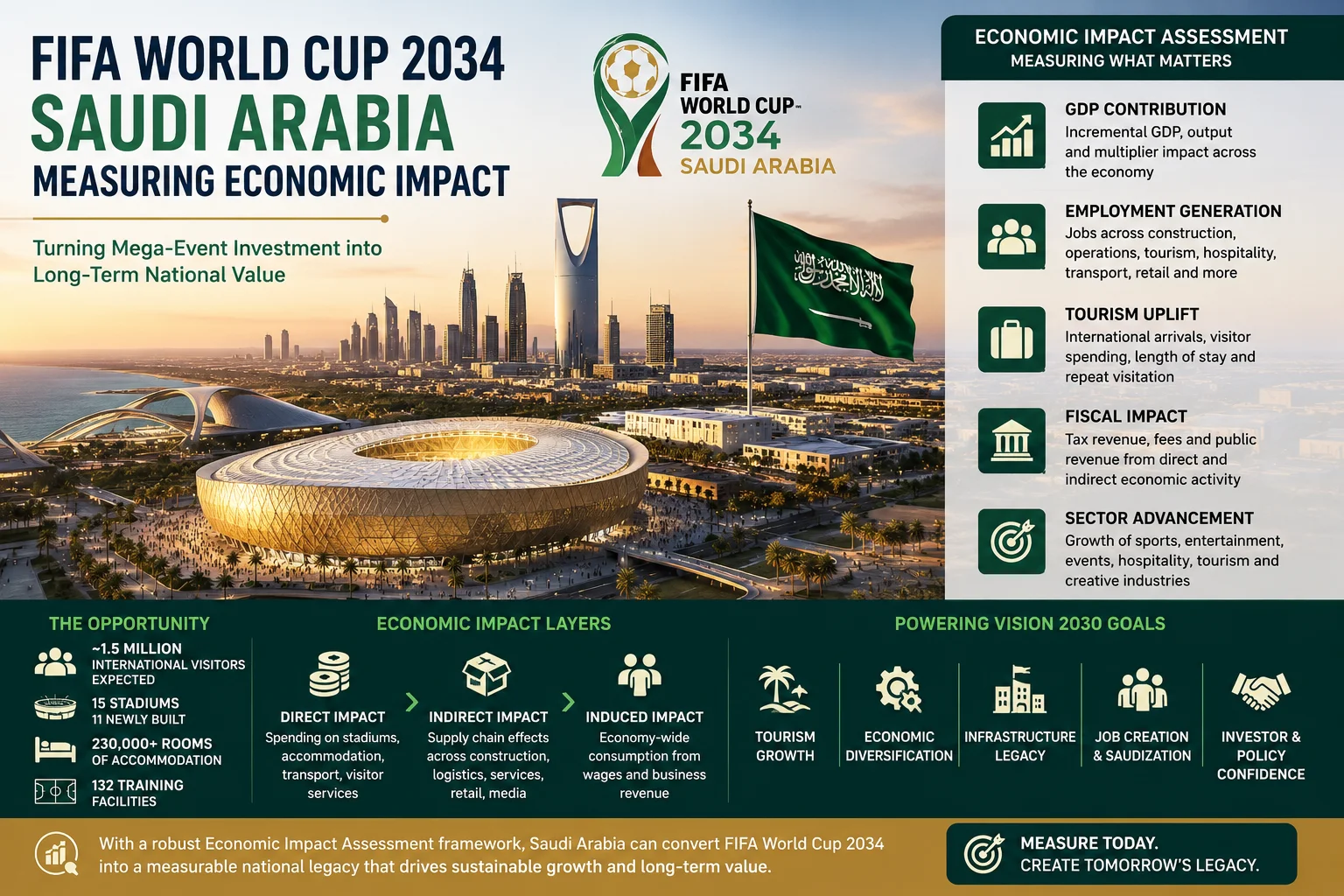
Saudi Arabia was confirmed as host on December 11, 2024, with a bid that scored the highest evaluation mark in tournament history. The plan spans Riyadh, Jeddah, Al Khobar, Abha, and NEOM, using 15 stadiums, eleven of them newly built, alongside 132 training facilities and more than 230,000 rooms of accommodation planned for teams, delegations, media, and fans. That’s an enormous development footprint, and the country is expecting roughly 1.5 million international visitors on top of it.
The opportunity here is genuinely unprecedented. So is the responsibility that comes with it, making sure all this momentum turns into something that actually lasts. This is exactly where Economic Impact Assessment, EIA, earns its keep. It’s not just a tool for measuring what happened after the fact. Done properly, it helps decision-makers guide where capital actually goes, stress-test different scenarios ahead of time, manage risk, and track whether the World Cup is genuinely building the kind of value Vision 2030 is aiming for.
Without a solid EIA framework behind it, the headline investments will still be visible, the stadiums, the roads, and the hotels. What tends to disappear without proper measurement is the quieter stuff underneath, repeat visitation after the tournament ends, how much local suppliers actually participated versus foreign contractors, whether workforce localization goals were hit, spillover effects at the city level, fiscal returns, whether private capital gets pulled in alongside public spending, and what actually happens to all this infrastructure once match day is over.
 What Economic Impact Assessment Actually Measures
 What Economic Impact Assessment Actually Measures
The starting point for any credible read on FIFA 2034 is quantifying its economic contribution in a way that holds up to scrutiny. That means building a structured framework across five core dimensions.
GDP contribution comes first, capturing incremental gross value added, output effects, and the wider multiplier impact that ripples out through the economy. Employment generation matters just as much, spanning construction, event operations, tourism, hospitality, transport, retail, and everything ancillary to those. Tourism uplift needs its own lens too, incremental international arrivals, domestic visitor spending, how long people actually stay, and whether they come back afterward. Fiscal impact covers tax receipts, fees, and public revenue generated both directly and through the wider economic activity the tournament sets off. And sector advancement looks at how the tournament accelerates Saudi Arabia’s sports, entertainment, events, creative industries, hospitality, and tourism ecosystems in line with Vision 2030’s broader diversification goals.
EIA gives all of this an analytical structure, making the value creation visible and, just as importantly, credible enough to act on. It typically breaks the footprint into three layers. Direct impact covers spending tied straight to stadium construction, accommodation, transport, and visitor-facing services. Indirect impact captures the supply-chain ripple across construction, logistics, professional services, media, and retail. Induced impact is the broadest layer, the economy-wide consumption effect as wages and business revenue circulate back through households and local markets. Put together, this reframes FIFA 2034 from a one-time sporting event into something closer to a measurable national value-creation system.
What Qatar 2022 Actually Showed
Mega events move real economies, not just crowds through turnstiles, and Qatar 2022 is the most useful recent benchmark for what that actually looks like in the numbers. The IMF estimated near-term tourism spending and World Cup-related broadcasting revenue at somewhere between $2.3 billion and $4.1 billion, equivalent to roughly 0.7% to 1.0% of Qatar’s 2022 GDP. That’s a meaningful contribution, but the bigger lesson isn’t really about the number itself.
Across regional and multi-country tournament models, one thing keeps showing up, scale alone doesn’t determine economic impact. What actually matters is how well the investment gets structured, measured, localized, and folded into a longer-term development strategy that outlives the event itself. For Saudi Arabia, this matters a lot, because FIFA 2034 doesn’t exist in isolation. It sits inside a much bigger national growth trajectory, tourism expansion, non-oil diversification, private-sector development, and a stronger position on the global stage.
EIA plays a central role in connecting those dots. It helps position FIFA 2034 as a genuine growth catalyst rather than just a sporting milestone, strengthens capital allocation and investor confidence by grounding decisions in evidence rather than optimism, gets ministries, host cities, developers, and private-sector partners aligned around a shared measurement framework, and gives everyone a clearer way to communicate what value is actually being created across economic, social, fiscal, tourism, and infrastructure outcomes at once.
Embedding FIFA 2034 Into Vision 2030
Saudi 2034 isn’t just a tournament milestone, it’s a genuinely high-visibility delivery platform for Vision 2030, and EIA can help turn that momentum into outcomes that are actually measurable and investable, not just aspirational.
That means tracking tourism acceleration, how international visitors, domestic travel, hotel demand, and repeat visitation strengthen Saudi Arabia’s tourism trajectory before, during, and well after the tournament wraps. It means quantifying economic diversification and how World Cup-linked demand deepens non-oil growth across hospitality, sports services, events, entertainment, transport, retail, media, and local supply chains. It means genuinely assessing infrastructure and giga-project utilization, whether stadiums, mobility upgrades, and hospitality capacity get folded into year-round urban and tourism ecosystems instead of sitting empty once the tournament ends. It means estimating job creation and Saudization properly, direct, indirect, and induced employment across construction, operations, tourism, and services, while identifying real skills pathways that support workforce readiness. And it means building investor and policy confidence, giving ministries, PIF entities, lenders, developers, and private investors a credible evidence base to shape incentives, partnerships, and capital allocation with real conviction rather than guesswork.
With the right EIA framework in place, Saudi decision-makers have a genuine shot at converting FIFA 2034 into a measurable national legacy, tying every major investment back to evidence rather than assumption.
How XentraView Thinks About This Kind of Work
The real opportunity for Saudi Arabia is making sure every riyal invested in FIFA 2034 actually translates into measurable national value. Without rigorous measurement in place, some of the highest-potential value pools, repeat visitation, local supplier participation, workforce localization, city-level spillovers, fiscal returns, and private-sector crowd-in risk going undermeasured or missed entirely.
This is the kind of research problem we’re built for, pulling fragmented investment data, sector benchmarks, and scenario planning into something decision-ready rather than another static report. An EIA approach worth doing properly blends macroeconomic modeling, sector benchmarking against comparable mega-events, stakeholder mapping, and clear executive reporting so that the people actually making capital decisions can see not just how much activity a given investment generates, but how much of that value actually stays within the Kingdom.
For organizations involved in planning, financing, or delivering major event-linked infrastructure, having a shared, credible evidence base makes it a lot easier to prioritize capital, evaluate trade-offs, de-risk delivery, and communicate impact with real confidence to stakeholders who are ultimately going to ask hard questions about return. Done well, that kind of framework becomes more than an after-the-fact assessment. It becomes a decision platform, one that shows where intervention is actually needed, where value can be amplified, and where the long-term returns are worth protecting well beyond the closing match in 2034.
