


Europe
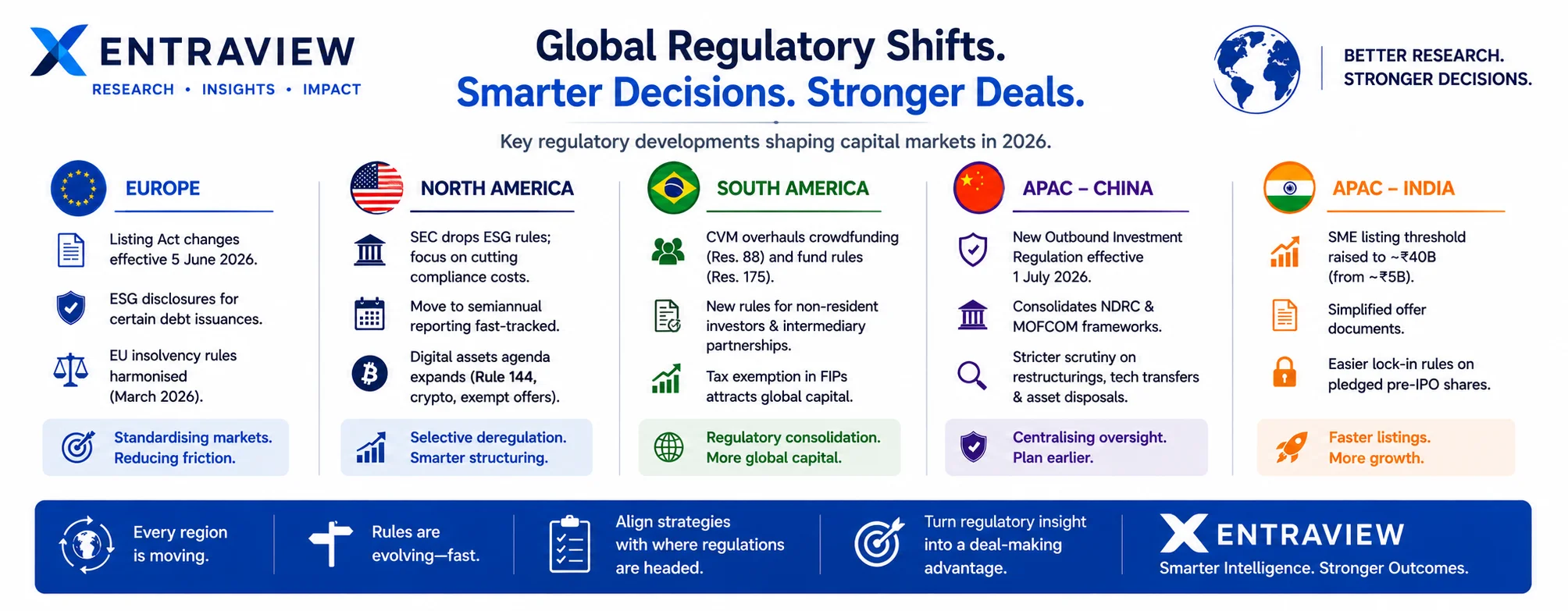
Europe’s capital markets agenda is now firmly in the implementation phase, and the pace has picked up. The final wave of changes under the EU Listing Act took effect on 5 June 2026, bringing new sequencing rules for standalone prospectuses, a shorter one-year audited financial information requirement, and mandatory ESG disclosures for certain debt issuances with a temporary gap between the delegated act’s adoption and its formal entry into force that ESMA addressed through public guidance directing market participants to the newly adopted rules. For issuers running follow-on offerings or debt programs on EU venues, this is the point where the Listing Act stops being a future consideration and starts shaping deal timetables directly.
Alongside the prospectus changes, the Council has been pushing other pieces of the Capital Markets Union forward. EU insolvency rules were harmonized at the end of March, intended to make the bloc more attractive to cross-border investors by reducing the friction created by differing national insolvency regimes and by increasing what creditors can recover from distressed companies. For firms doing cross-border diligence or structuring deals with EU counterparties, this is one more sign that Brussels is treating market integration as an active project rather than a settled one.
 North America
 North America
The US direction of travel remains capital formation first. The SEC’s current agenda dropped several prior ESG-related rulemakings and replaced them with items aimed squarely at reducing public-company compliance costs, including active support from the current chairman for moving from quarterly to semiannual financial reporting, an idea the agency is now fast-tracking through rulemaking. Separately, the digital assets docket keeps expanding: recent proposals cover Rule 144 safe harbors, crypto asset treatment, and updates to exempt offering pathways, all relevant to how tokenized instruments and private placements get structured going forward.
M&A activity itself has its own story this cycle. A notable jump in mega-deal activity has renewed attention on how large joint ventures and carve-outs get negotiated, with practitioners pointing out that mid-sized carve-out transactions can carry more structuring complexity than headline-grabbing multibillion-dollar deals. Deal teams sourcing or evaluating opportunities in this environment need research that keeps pace with a regulatory backdrop that is loosening in some areas and tightening in others depending on the asset class.
South America
Brazil’s regulator is heading into a genuine overhaul rather than incremental tweaks. The CVM’s 2026 regulatory agenda includes a full redesign of the crowdfunding framework under Resolution 88, along with revisions to Resolution 175’s annexes covering private equity funds, fixed-income funds, and real estate funds. The agency has also flagged work on reporting requirements for non-resident investors and updated rules for intermediary partnerships with foreign institutions, both of which matter directly to funds and platforms with cross-border capital flows into Brazil.
This builds on a broader trend already underway. Recent reforms, including a capital gains tax exemption for foreign investors in FIPs, have been credited with drawing in international capital and strengthening institutional participation in Brazil’s private equity market. Regulatory consolidation is making the market more legible to outside investors, which is exactly the kind of shift that changes where global capital chooses to go next.
APAC
China’s outbound investment regime just underwent its biggest structural change in years. The new Regulation on Outbound Investment, effective 1 July 2026, is the first instrument of its kind issued directly by the State Council rather than at the ministerial level, and it consolidates the previously separate NDRC and MOFCOM frameworks into a single, more enforceable structure. The rules specifically bring offshore restructurings, technology transfers through licensing or personnel deployment, and disposals of existing overseas assets under direct regulatory scrutiny. Any deal involving a Chinese counterparty now needs security review exposure checked earlier in the process, not as a late-stage formality.
India, meanwhile, is loosening rather than tightening. SEBI is reportedly preparing to let companies valued at up to roughly 40 billion rupees use SME listing platforms, a significant jump from the roughly 5 billion rupee threshold that has typically applied. Combined with earlier moves to simplify offer documents and ease lock-in enforcement on pledged pre-IPO shares, the direction is clearly toward faster, less friction-heavy listings, at a time when SME IPO volumes on India’s exchanges have already been climbing fast.
The Common Thread
Every region here is moving, just not in the same direction. Europe is standardizing, the US is deregulating selectively while tightening around digital assets, Brazil is consolidating its fund framework, China is centralizing national security review over outbound capital, and India is opening its listing doors wider. None of these shifts sit still long enough to plan around once and forget. Keeping deal sourcing, due diligence, and market entry decisions aligned with where each of these frameworks is actually headed, rather than where they stood last quarter, is what turns regulatory tracking from a compliance chore into an actual edge in sourcing and closing deals.
