


A Shift That’s Easy to Miss
For most of the last two decades, external financing carried a huge share of global health progress across large parts of the developing world. HIV treatment, immunization campaigns, malaria control, and maternal health, a lot of it ran on money that came from somewhere else. That worked, for a long time. It’s now changing, and changing faster than a lot of institutions are set up to respond to.
The easy read is that donors are simply pulling back. Cutting checks, walking away. What’s actually happening in a lot of cases is more specific than that: funding isn’t disappearing so much as it’s being redirected, restructured, and repriced according to different priorities than it used to follow. That shift is landing at a moment when a lot of domestic health and finance systems are not fully ready to absorb it.
Anyone trying to plan around this, a foundation setting a country strategy, a government preparing for a funding transition, a partner deciding where to commit next, runs into the same two questions. Why are donors actually behaving the way they are? And are the systems on the receiving end ready to pick up what’s being handed off?
Most institutions answer both questions with shortcuts. Income thresholds. Headline aid totals. Assumptions about donor intent that don’t hold up well under scrutiny. Readiness gets treated as a date on a calendar instead of something that actually gets verified. That’s usually where things start to go wrong.
 This Is Mostly a Judgment Problem
 This Is Mostly a Judgment Problem
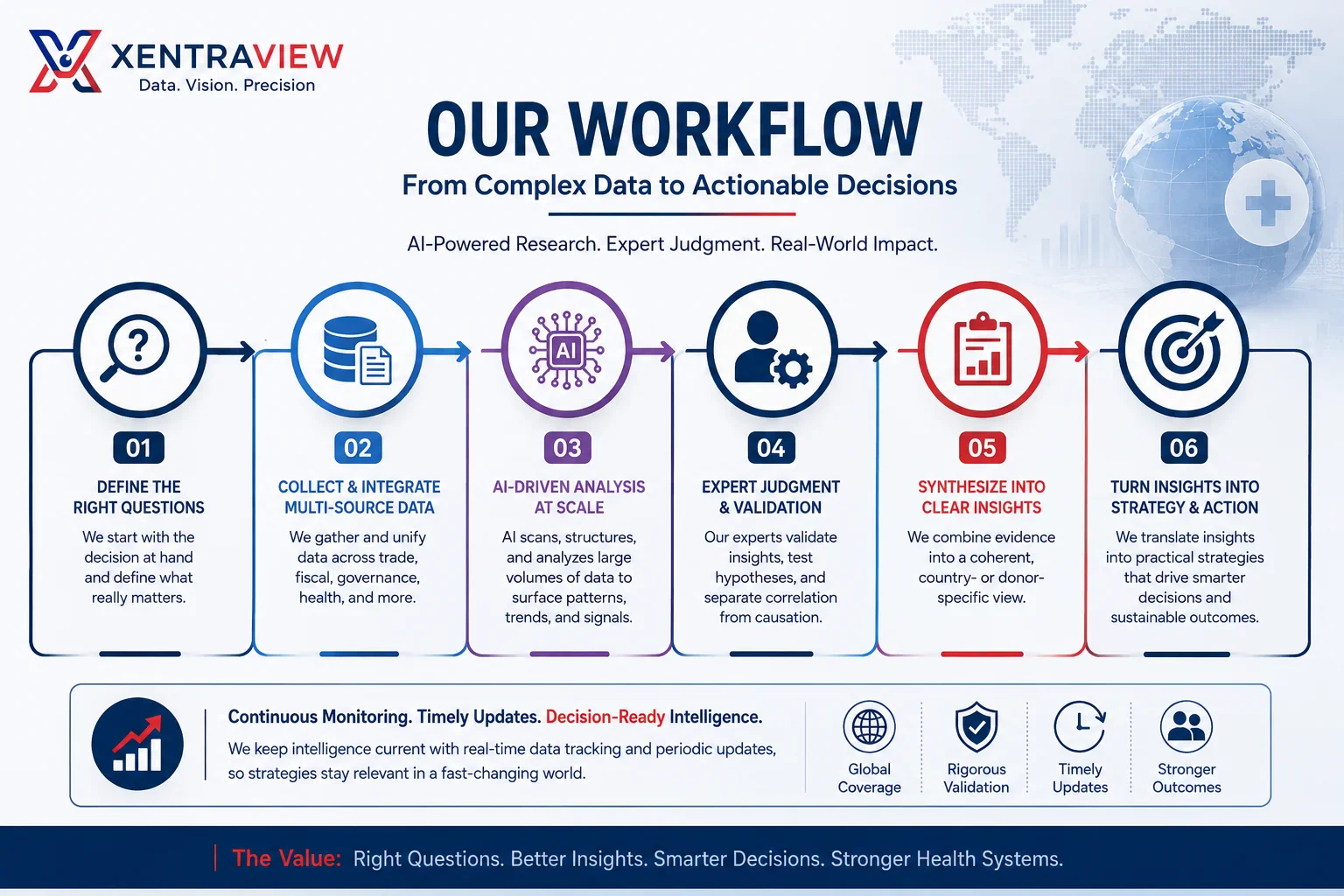
Here’s the thing worth sitting with: the raw data mostly already exists. Trade flows, official development assistance broken down by stream, debt and fiscal indicators, governance scores, disease burden data, and budget execution rates. None of this is hidden. Public databases are full of it.
The actual difficulty is that all of this evidence lives in different places, speaks a different analytical language, and moves on a different clock. Trade statistics and foreign policy documents tell you something about donor intent. Debt and revenue data tell you about fiscal room. Budget execution numbers tell you whether a government can actually deliver, separate from whether it says it can. Governance indicators only really tell you anything meaningful once you track them over time, not as a single snapshot.
Pulling all of that into one coherent, decision-ready view of a country, fast enough to actually act on, is the real work. Most teams don’t struggle because they can’t find the data. They struggle because synthesizing it is slow, fragmented, and demands a level of cross-domain analysis that’s genuinely hard to do well under time pressure.
This is where AI, used carefully and paired with real domain expertise, starts to change the math. It can scan and structure large volumes of policy, trade, fiscal, and governance material at a scale no analyst team could match manually, surface patterns across dozens of indicators at once, and flag where different signals agree with each other and where they quietly contradict one another. What it can’t do on its own is judgment. Someone still has to frame the right hypotheses, tell causation apart from coincidence, check the output against what’s actually known in the literature, and turn all of it into something a leader can act on with confidence. The expertise leads. The AI does the heavy lifting underneath it. That combination is what actually turns a flood of indicators into an answer instead of just a bigger pile of data.
What This Looks Like in Practice
At XentraView, we think about this kind of work the same way we think about any research problem that involves fragmented, fast-moving evidence: start with the questions that actually matter to the decision at hand, not the data that happens to be easiest to pull. That usually means building a country or donor view that pulls together fiscal, political, and sector-specific signals into one picture instead of five separate reports that never quite agree with each other.
A few habits tend to separate institutions that navigate this kind of transition well from ones that get caught flat-footed.
They read the shift early, based on what donors are actually doing and where their money is actually flowing, rather than waiting for an official cut to be announced. They pace any transition to a country’s verified capacity to absorb it, not to an income threshold or a graduation date set years earlier under different conditions. They think hard about which gains are most fragile, the ones built almost entirely on external financing tend to be the most exposed when that financing shifts, and they sequence their response accordingly instead of assuming continuity. And they resist the urge to apply one financing template everywhere. What fits one country’s fiscal and political profile often doesn’t fit the next one at all.
None of this is a one-time exercise, either. Donor postures shift. Fiscal positions shift. Political conditions shift, sometimes within a single budget cycle. A transition strategy built on last year’s read is already out of date by the time it’s implemented. The value isn’t in producing a single sharp analysis. It’s in keeping that analysis current, comparable across countries, and actually tied to the decisions it’s meant to inform.
The Bigger Picture
This kind of funding realignment isn’t an isolated story in global health. It’s one visible instance of something happening across development finance more broadly. There’s no real shortage of data out there, and there’s no shortage of dashboards either. What’s genuinely scarce is decision-ready synthesis, the kind that pulls fragmented evidence into a clear, current, country-specific answer someone can actually act on.
Closing that gap isn’t about building a better dashboard. It’s about combining the domain expertise to ask the right questions with AI that can carry the heavy synthesis work across trade, fiscal, governance, and sector-specific data faster than any team could manage by hand, and then having the discipline to turn what comes out of that into an actual strategy rather than another report that sits on a shelf.
The institutions that get ahead of this transition won’t be the ones with access to the most data. They’ll be the ones that got serious, early, about reading it well.
