


Going overseas has stopped being a nice-to-have for Chinese foodservice and retail brands. In a domestic market this saturated and this competitive, it’s turned into one of the few real paths left to growth. Southeast Asia, with a population north of 620 million and a demographic profile skewed genuinely young, has moved past being a testing ground and become something closer to a required stop on the globalization map for these companies.
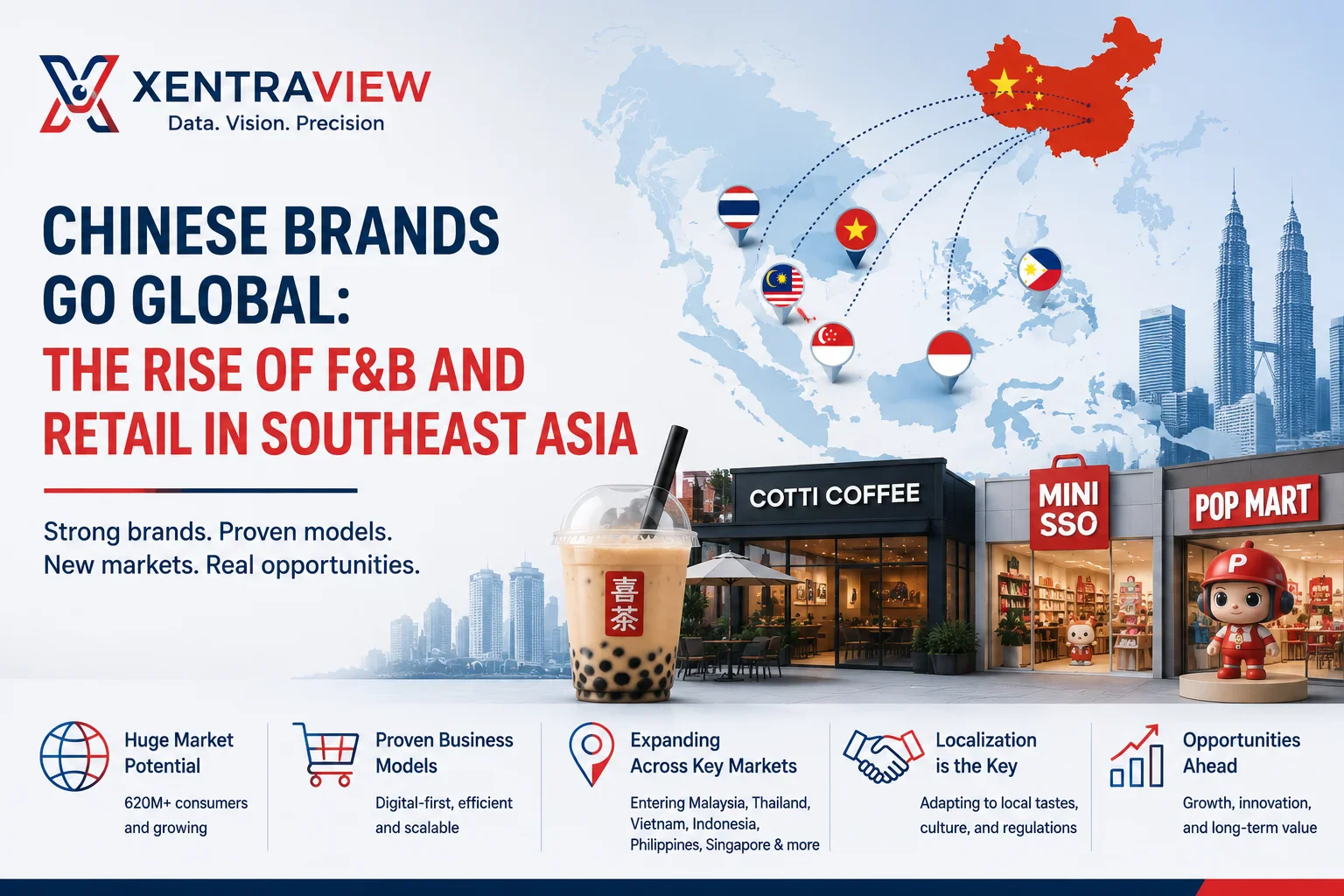
Mixue, Haidilao, and MINISO paved the way across several Southeast Asian markets, and now Tai Er, Cotti Coffee, and Pop Mart are picking up the pace behind them. Newer full-service chains like Green Tea Restaurant are stepping onto the international stage too. These companies bring genuinely strong digital capabilities and mature supply chains with them, and the instinct is to take what worked at home and run it back overseas. The problem is that Southeast Asia isn’t one market pretending to be several, it’s genuinely several markets, and a lot of companies walk in with real confidence but very thin visibility into what actually makes each country different. Getting past assumption and into real localization has become one of the defining tests for this generation of brands going global.
 The New Wave: How Chinese Brands Are Actually Entering the Region
 The New Wave: How Chinese Brands Are Actually Entering the Region
Southeast Asia’s combined retail and foodservice market is on track to grow from about $77.8 billion in 2023 to roughly $108.2 billion by 2030, a compound annual growth rate of around 4.9%. Steady, structurally improving growth, not a boom, which matters for how brands should think about timing their entry.
Chinese brands aren’t moving into this at the same pace or through the same playbook, though. Three categories have emerged as the real drivers behind cross-border expansion.
The first is tea, coffee, and light food, with brands like Mixue, CHAGEE, Luckin Coffee, and Cotti Coffee. CHAGEE is a good case study in localization through joint ventures, while Luckin shows what exporting a digital-first operating model actually looks like in practice. CHAGEE completed its Nasdaq listing in April 2025, raising roughly $411 million and reaching a market valuation near $7.5 billion on debut, and it used that momentum to push harder into Southeast Asia. In Thailand, it partnered with a leading local food group through a joint venture structure, a move that helped it sidestep restrictions on foreign ownership. In Malaysia, it expanded through a JV with local capital partner Magma Chain. By August, CHAGEE had entered the Philippines outright, opening its first three stores in premium Manila shopping centers and pushing its regional footprint to five countries. The pattern, which proved the model with company-owned stores first, then opened the door to partnerships, was built in China and carried over intact. Luckin Coffee, meanwhile, has moved into a straight replication phase in markets like Singapore and Malaysia, transplanting its app-ordering and pickup model largely as-is to get high operating efficiency out of each store.
Full-service dining has its own standout story in YONNY, which pairs a highly standardized signature dish with a premiumized brand experience. In 2025 the company rolled out a global brand refresh in Thailand, working in Eastern design cues, flying fish imagery, traditional screens, and Sichuan-Chongqing cultural themes into its stores. Its Malaysia 5.0 concept store opened in Kuala Lumpur in August and reportedly turned tables nine times on opening day alone. Six stores followed in Malaysia at once, then another six-store wave after that. The dish itself, sauerkraut fish, is standardized enough that it travels well, and combined with China’s blockbuster-product-plus-rapid-rollout formula, it let the brand build real regional density before local competitors had time to respond.
New retail and lifestyle brands tell an even sharper version of the same story. Pop Mart has consistently drawn some of the heaviest foot traffic of any Chinese brand operating across Southeast Asian shopping centers, and it’s done that without leaning much on product localization at all. What it exports instead is the IP-based marketing system it built and refined in China. Limited editions create scarcity, pop-ups create buzz, and social sharing does the rest. That’s an emotional-consumption ecosystem that’s genuinely hard for local competitors to copy, and it’s probably the closest thing the brand has to a real moat.
Put these together, and the underlying pattern is clear. These brands aren’t just exporting products. They’re exporting standardized operating systems, organizational structures, and management processes that have already been stress-tested in one of the most competitive consumer markets on earth. For a lot of Southeast Asian competitors still running on individual operator instinct and experience-based management, that’s a genuine structural edge. What’s crossing the border isn’t stores. It’s entire business systems.
Four Structural Barriers Standing in the Way
Strong digital capability and efficient rollout playbooks are enough to get a brand into a market. Staying there long term means dealing with religious, political, and cultural realities that don’t show up in a spreadsheet. Southeast Asia’s diversity means thin visibility into local conditions gets punished fast.
Religion and halal certification aren’t optional. Indonesia and Malaysia are majority Muslim, Thailand is largely Buddhist, and the Philippines is predominantly Catholic. One product lineup simply doesn’t travel across all of that. A common mistake is underestimating how deep halal compliance actually runs, it touches raw materials, cross-border logistics, central kitchens, and even how utensils get cleaned. When Mixue expanded aggressively into Indonesia, it ran into real public scrutiny before its halal certification came through and had to work through an accelerated certification process alongside a fair amount of public explaining. Full-service brands like Tai Er and Green Tea Restaurant face the same wall from a different angle, traditional Chinese recipes often lean on pork fat, cooking wine, or imported sauces that don’t clear local standards, which means real recipe reformulation, not cosmetic tweaks. Haidilao’s response is instructive here. It launched Sizzling Hotspot in Indonesia in January 2026 as its first fully halal-certified brand, built around a “no pork, no lard” concept with menu items reworked around local Nusantara flavors like rendang and laksa broth. Halal certification has stopped being a compliance checkbox. It’s the actual gateway to the mainstream market.
Supply chains fragment fast once you leave China. The centralized logistics that work so well domestically run straight into island geography and inconsistent infrastructure in places like Indonesia and the Philippines. Inter-island transport often means stacking multiple layers of distribution, cold-chain capacity varies wildly by location, and fulfillment routes end up longer and messier than anyone planned for. Add in customs clearance, phytosanitary certificates, food safety registration, import declarations, and tariff structures that differ country to country, and a single unified supply chain model just doesn’t hold up. Most brands end up shifting toward a hybrid, localized sourcing approach instead. Luckin Coffee and Cotti Coffee both adopted dual sourcing after entering Singapore, Malaysia, and Thailand, blending cross-border imports with local procurement. CHAGEE leaned on its Thailand joint venture specifically to tap into an established local supply chain and distribution network rather than building one from scratch.
Copying the China SKU lineup rarely works. One of the more common and more avoidable mistakes is assuming a winning product mix in China will translate unchanged. One Chinese retail brand kept a heavy selection of distinctly Chinese snacks, spicy gluten strips among them, on Indonesian shelves, betting on appeal to the local Chinese community. Most of the actual customers were local Indonesians who had never encountered the products and weren’t particularly interested once they had. The stock eventually had to be cleared at deep discounts. Tea brands have learned to adapt more deliberately. Mixue adjusted its Southeast Asian lineup toward iced drinks, tropical fruit flavors, and value pricing, and tuned sweetness levels and tea bases to local palates instead of shipping its China menu wholesale. CHAGEE did something similar entering Indonesia, tailoring roughly a fifth of its menu to local tastes on top of securing halal certification before launch, which took a real bite out of both religious and preference-related risk at once. The lesson holds across categories, success depends less on replicating what worked at home and more on knowing precisely which parts of the portfolio to keep, adapt, or cut.
Labor and management culture misalignment tends to sneak up on people. It looks like a soft operational issue right up until it isn’t. The high-intensity, rapid-hiring management style common at Chinese restaurant and retail companies runs into stricter labor protections and stronger employee-rights enforcement across most of Southeast Asia. Local employees generally place real weight on religious observance and work-life balance, daily prayer schedules, Ramadan adjustments, religious holidays. Companies that try to import Chinese management practices wholesale, without adjusting for any of that, tend to see turnover spike in ways they didn’t anticipate. Regulators have also gotten more active. Malaysia has run joint enforcement operations against people conducting business on tourist visas, including cases involving Chinese nationals operating automotive workshops and coffee shops without proper authorization. Indonesia has launched similar campaigns and pulled licenses from noncompliant foodservice operations. Culturally, China’s efficiency-first management style, long hours, intense performance targets, tends to clash with a region that puts real weight on work-life balance. Thailand caps additional weekly overtime, Malaysia caps standard working hours and enforces overtime rules, and overlooking things like prayer times or religious holidays is a fast way to end up in a labor dispute. Success here depends on more than operational excellence. It depends on genuinely adapting people management to local realities instead of exporting the domestic playbook unchanged.
Beyond Replication: What Building Local Roots Actually Looks Like
Southeast Asia is becoming a real growth engine for Chinese foodservice and retail brands, and the story cuts both ways. There’s a genuine structural advantage on one side and a set of systemic challenges on the other that nobody gets to skip.
On the opportunity side, these brands are exporting far more than menus and store formats. They’re bringing operating systems refined under some of the most intense competitive pressure anywhere in the world. Mixue’s value-driven expansion, CHAGEE’s joint-venture model, Luckin’s digital store ecosystem, YONNY’s category-focused playbook, Pop Mart’s IP-driven engagement engine, different approaches, the same underlying foundation, and business models already proven at scale before they ever crossed a border. That’s the real edge these companies carry with them.
But a strong system doesn’t automatically translate into local success on its own. Southeast Asia is a mosaic of countries, cultures, languages, and religions, not a single market wearing different flags. Any strategy built on the assumption it can be treated as one homogenous region tends to run into trouble the moment it hits execution.
The brands that end up winning long term will be the ones that can export what actually works while genuinely respecting what’s different on the ground. Southeast Asia rewards both strong execution and real local insight in roughly equal measure. Expanding overseas was never really about repeating what worked at home. It’s about building something new, again, in a market that plays by its own rules.
